Brent's steepest weekly drop since 2020; US rigs at 2024 high
Global pipe-relevant markets swung hard this week: oil gave back its war-risk premium at the fastest pace since the pandemic began, the US rig count climbed to its highest level in more than two years, and China’s weekly steel export shipments hit a 13-week peak. Here is what changed, what is confirmed, and what it means for seamless pipe buyers.
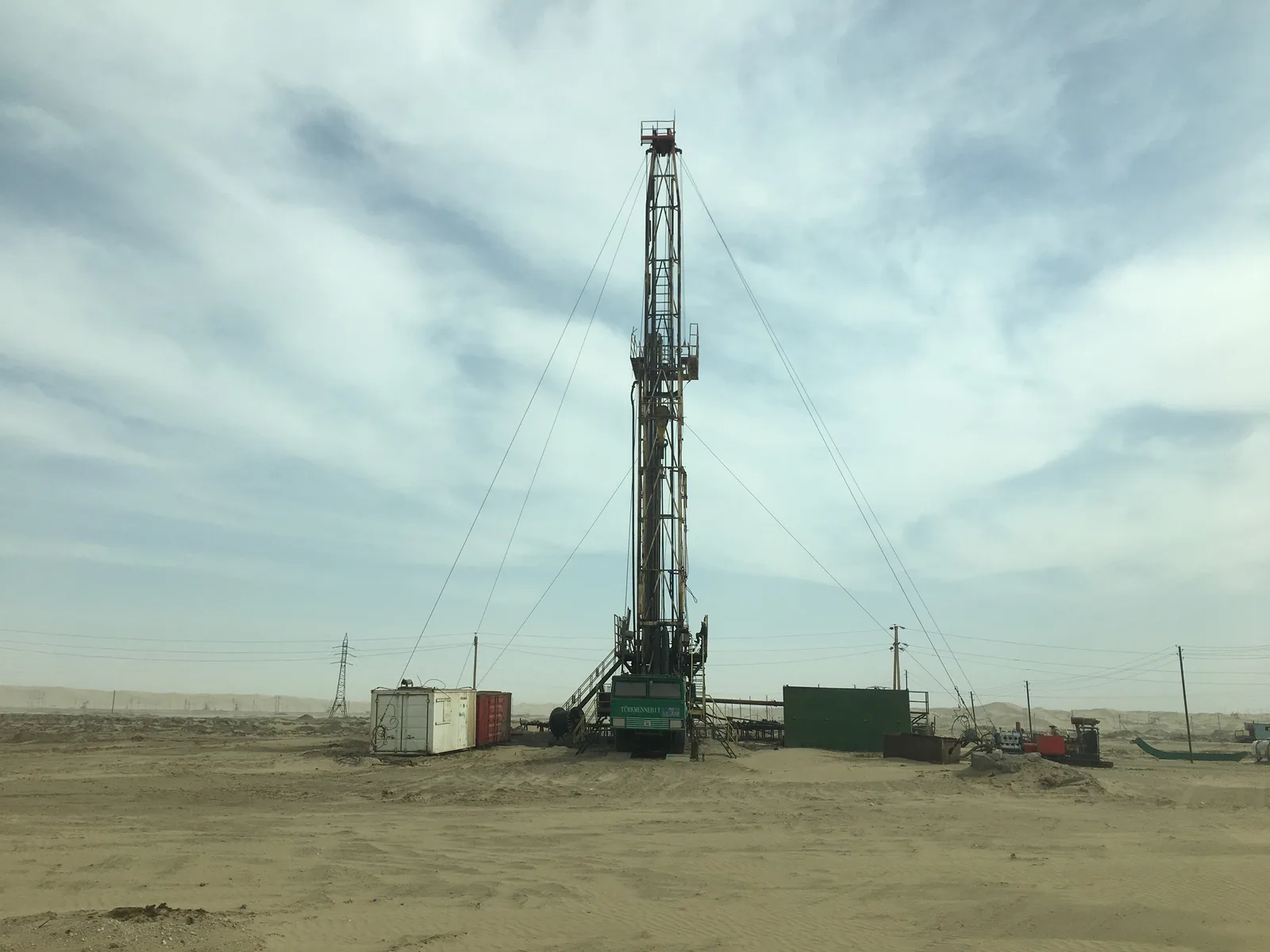
Cover photo: onshore drilling derrick on the Cheleken Peninsula, Caspian Sea. Credit: Allan Mustard (Wikimedia Commons); licence CC BY-SA 4.0; original file page. Resized and converted for this page; file photo shown for illustration and not connected to any party named on this page.
What moved this week
Brent crude settled 5.85% lower at USD 92.57 a barrel on Monday, November 9, and US West Texas Intermediate settled 4.38% lower at USD 86.85; both benchmarks kept falling after settlement, with Brent losing more than USD 7 a barrel at one point to its lowest since late August (Yahoo Finance/Reuters; VietnamPlus; PFL Petroleum). The slide came after President Trump said on November 8 that fresh strikes on Iran were “highly unlikely” as long as talks progressed — even though shipping attacks in or near the Strait of Hormuz continued (Yahoo Finance/Reuters; all.sg).
The correction extends a brutal week: Brent lost 16% over the seven days to November 6, its steepest weekly drop since the start of the COVID-19 pandemic (Yahoo Finance/Reuters). The physical market is loosening too — JPMorgan estimates the global crude surplus widened to 1.4 million barrels per day in October, and Iraq has reached understandings with the US to route exports through a designated lane near Oman (Yahoo Finance/Reuters). Yet the safety buffer is thinner than headlines suggest: the US Strategic Petroleum Reserve stood at 282.2 million barrels in the week ending October 30, down 127.4 million barrels, or 31.1%, from a year earlier (EIA, Week Ending 10/30/2026).
US rig count: highest since May 2024
Against that price backdrop, drilling activity is still rising. Baker Hughes data show the US oil and gas rig count rose by one to 604 in the week ending November 6 — 463 oil rigs, 131 gas rigs, and the first increase in four weeks (SteelOrbis). Reuters frames the milestone: the total is now the highest since May 2024, and oil rigs are at their highest since May 2025, with the overall count up 56 rigs, or 10%, year on year (BOE Report/Reuters). The prior week had been flat at 603 rigs (SteelOrbis), and North America as a whole stood at 827 rigs, up 88 year on year despite a 3-rig drop in Canada (OilVoice).
Rigs lead OCTG demand with a lag. EIA’s October 6 Short-Term Energy Outlook already projected US crude output rising from a record 13.7 million b/d in 2025 to 13.9 million b/d in 2026 (EIA STEO) — background consistent with the Q3 dynamics we covered in last week’s OCTG duties report, where Tenaris flagged firm North American OCTG demand into Q4 (Tenaris Q3 release). New from the same company’s November 5 call: awards for OCTG, line pipe and coating on Eni’s Cronos project offshore Cyprus, and unconditional EU clearance for the Artrom acquisition in Romania (call transcript) — incremental detail on casing and tubing demand, not a new event.
Oil’s 16% weekly slide and the freight-cost math
For pipe exporters, the fastest-moving cost lines this week were energy and marine risk. We reported on November 3 how Hormuz transit friction was inflating export costs for Gulf-bound flows (that report); the direction has now reversed, with the war-risk premium unwinding as diplomacy advances. Two caveats matter. First, attacks on shipping in or near the Strait continue, so the premium can return as fast as it left (all.sg). Second, trade costs are not easing in step: US and Canadian officials are still negotiating relief from Section 232 steel tariffs of up to 50% on Canadian steel (SteelOrbis/Reuters).
China export shipments at a 13-week high
On the supply side, Mysteel’s weekly tally shows Chinese steel export shipments reaching 2.9074 million tonnes in the week of October 27 to November 2, up 24.0% week on week and 18.5% year on year — the strongest in 13 weeks, with Singapore transshipment alone at 1.2821 million tonnes (Mysteel). That rebound followed two softer weeks (2.3452 million tonnes in the week to October 26; 2.1640 million tonnes the week before) and a year-high 3.0467 million tonnes in the week of October 6-12 (Mysteel via NetEase, 2026-10-28; 2026-10-15). Big-vessel clustering keeps weekly numbers noisy, but the level is above the 2026 weekly average.
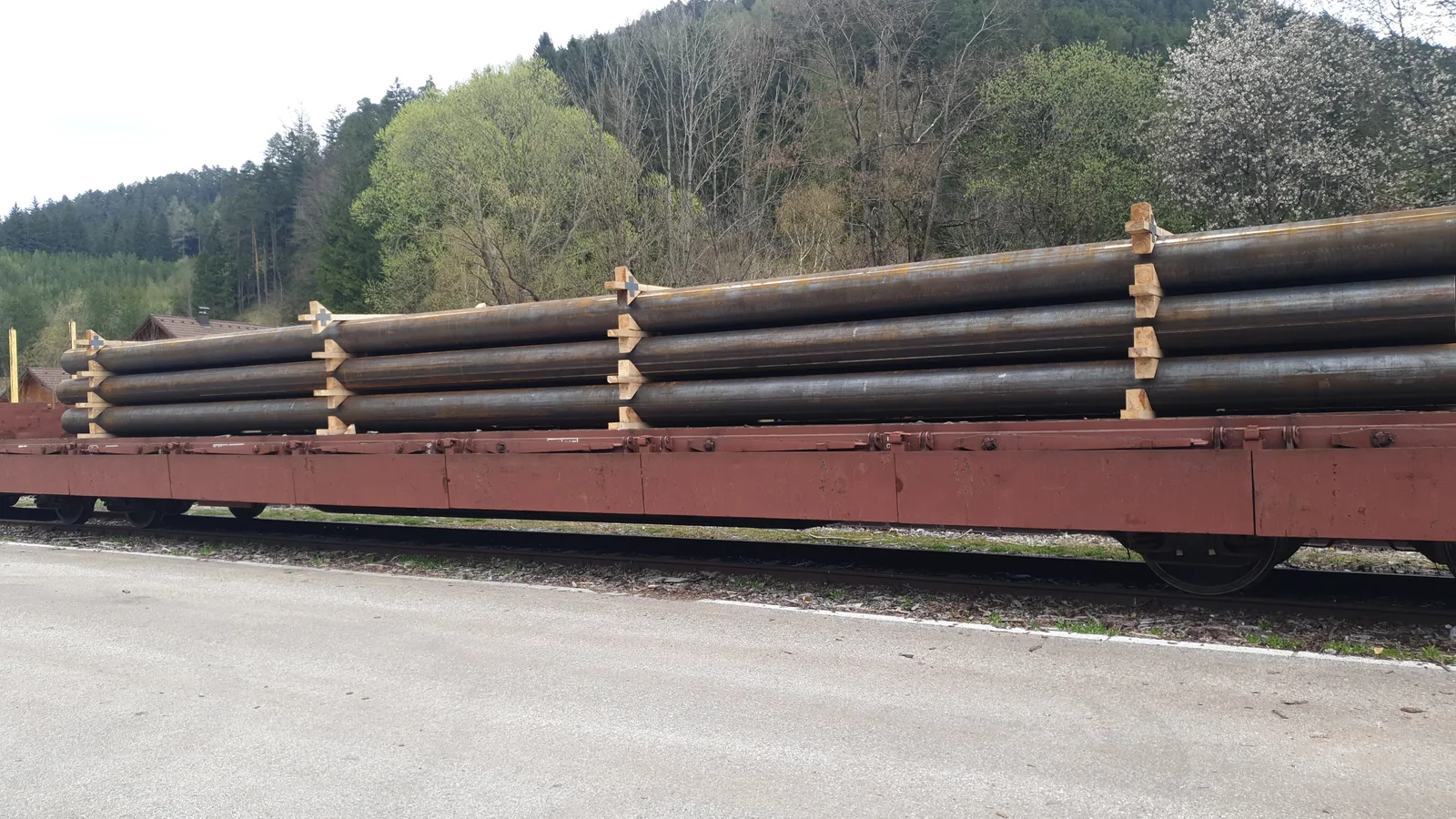
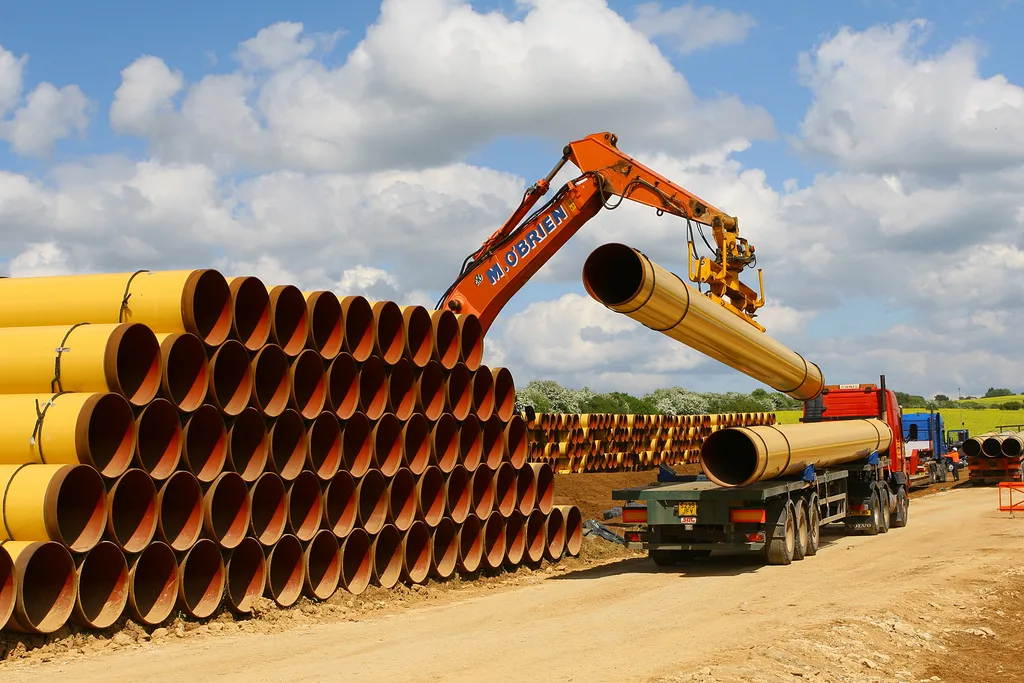
Photo: large-diameter steel pipes on rail flatcars, Austria. Credit: AlexHauss2608 (Wikimedia Commons); licence CC BY-SA 4.0; original file page. Resized and converted for this page; illustrative photo not connected to any party named on this page.
Input costs: China PPI and iron ore
China’s October PPI rose 5.7% year on year (up 0.7% month on month), with mining-and-quarrying output prices up 27.9% on energy costs; for steelmakers the input mix is mixed — fuels and power purchase prices were up 18.6%, while ferrous-metal materials were down 1.1% year on year (NBS, 2026-11-09). Iron ore, meanwhile, broke below USD 90/t on the Singapore Exchange in mid-October for the first time since 2024 before stabilizing (Mysteel). Softer raw-material costs partly cushion Chinese pipe mills even as energy-driven PPI stays elevated.
What seamless pipe buyers should watch
- OCTG demand signals are strengthening, but prices are two-sided. A 604-rig count — the highest since May 2024 — supports casing and tubing consumption into 2027, while the 16% crude slide shows how quickly sentiment can swing. US OCTG landed costs already carry the preliminary antidumping margins from November 4 (that report).
- Export freight and insurance: the risk-premium unwind lowers the energy-and-marine component of delivered cost for Middle East routes, but keep contingency allowances — incidents near Hormuz are still occurring, and the premium has repriced within days before (Yahoo Finance/Reuters). Line-pipe buyers planning API 5L line pipe projects can revisit freight assumptions more frequently for now.
- China export cadence: a 13-week shipment high plus tightening trade barriers (the EU quota regime we covered on November 2 and the new US AD/CVD cases we reported yesterday) argue for booking slots early rather than reading one strong week as a trend. For the seamless-vs-welded split by application, see our explainer.
Sources
- SteelOrbis — US rig count increases, week 45, 2026 (2026-11-06)
- BOE Report/Reuters — Rig count highest since 2024 (2026-11-06)
- Yahoo Finance/Reuters — Oil slides as Trump signals restraint (2026-11-10)
- VietnamPlus — Oil prices plummeted (2026-11-09)
- PFL Petroleum — Daily report 11-9-2026
- all.sg — Hormuz risks persist (2026-11-09)
- OilVoice — North America rig count (2026-11-06)
- SteelOrbis — Week 44 rig count (2026-10-31)
- EIA — Weekly Petroleum Status Report, week ending 10/30/2026 (2026-11-05)
- EIA — Short-Term Energy Outlook (2026-10-06)
- Mysteel — Weekly export shipments 10.27-11.2 (2026-11-04)
- Mysteel — SGX iron ore page and flashes (2026-11-09)
- NBS — October 2026 PPI (2026-11-09)
- SteelOrbis/Reuters — US-Canada steel tariff talks (2026-10-27)
- Yahoo Finance — Tenaris Q3 release (2026-11-05)
- Roic.ai — Tenaris Q3 call transcript (2026-11-05)
- Mysteel via NetEase — shipments 10.20-10.26 (2026-10-28)
- Mysteel via NetEase — morning brief, year-high week (2026-10-15)