Hormuz Still Off-Limits: China Seamless Pipe FOB Slides to $609/t
Eleven months into the Gulf shipping crisis, the Strait of Hormuz is still not a normal waterway — and the cost is now showing up in Chinese seamless pipe export quotations. On 2 November the International Maritime Organization said it could not confirm that mines had been cleared from the strait’s traffic-separation scheme and still advised ships against transiting it, while Chinese export offers for ASTM A106B seamless pipe at Tianjin port have slid for a third straight week to USD 609 per tonne. Two of China’s listed steelmakers separately confirmed this month that Middle East logistics are eating into their order economics, even as domestic supply and inventories stay heavy. For buyers pricing Gulf-bound tubulars, the gap between FOB China and landed Middle East cost keeps widening.
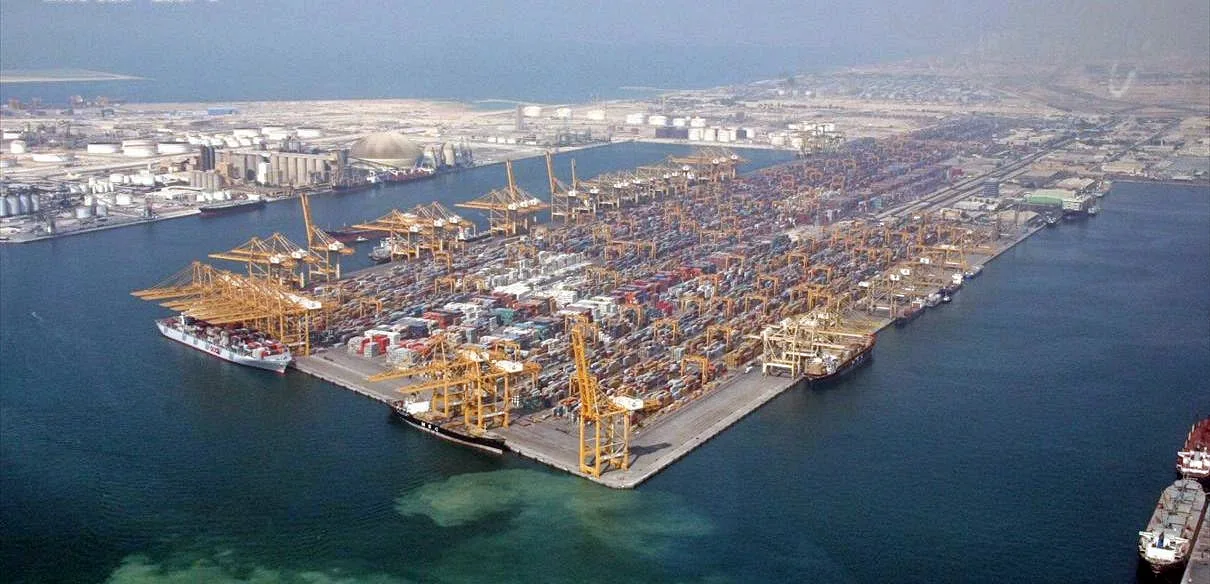
Cover photo: aerial view of the container terminal at Jebel Ali Port, Dubai — a Gulf gateway whose inbound routings have been repeatedly reworked since February 2026. Credit: Imre Solt (Wikimedia Commons); licence CC BY-SA 3.0; original file page. Resized and converted for this page; the photograph is illustrative and is not connected to any named shipper, carrier or shipment.
The strait is still not safe to transit
At a 2 November press conference at IMO headquarters in London, IMO chief Dominguez said he had received no confirmation that mines had been cleared from the traffic-separation scheme, that transit safety could not be guaranteed, and that he continued to call on ships to stay away from the strait. CCTV’s report of the same briefing adds the operational numbers: the IMO logged roughly 30 attacks on shipping in and around Hormuz during October — one of its highest monthly counts — and nearly 400 vessels carrying about 6,000 seafarers remain stuck in the Gulf region. Iran claims vessels have struck mines while sailing “unauthorized” routes; US Central Command publicly denies mines remain in the international channel. The point for cargo owners is that the referee of record will not certify the waterway as safe, eight months after the conflict began on 28 February.
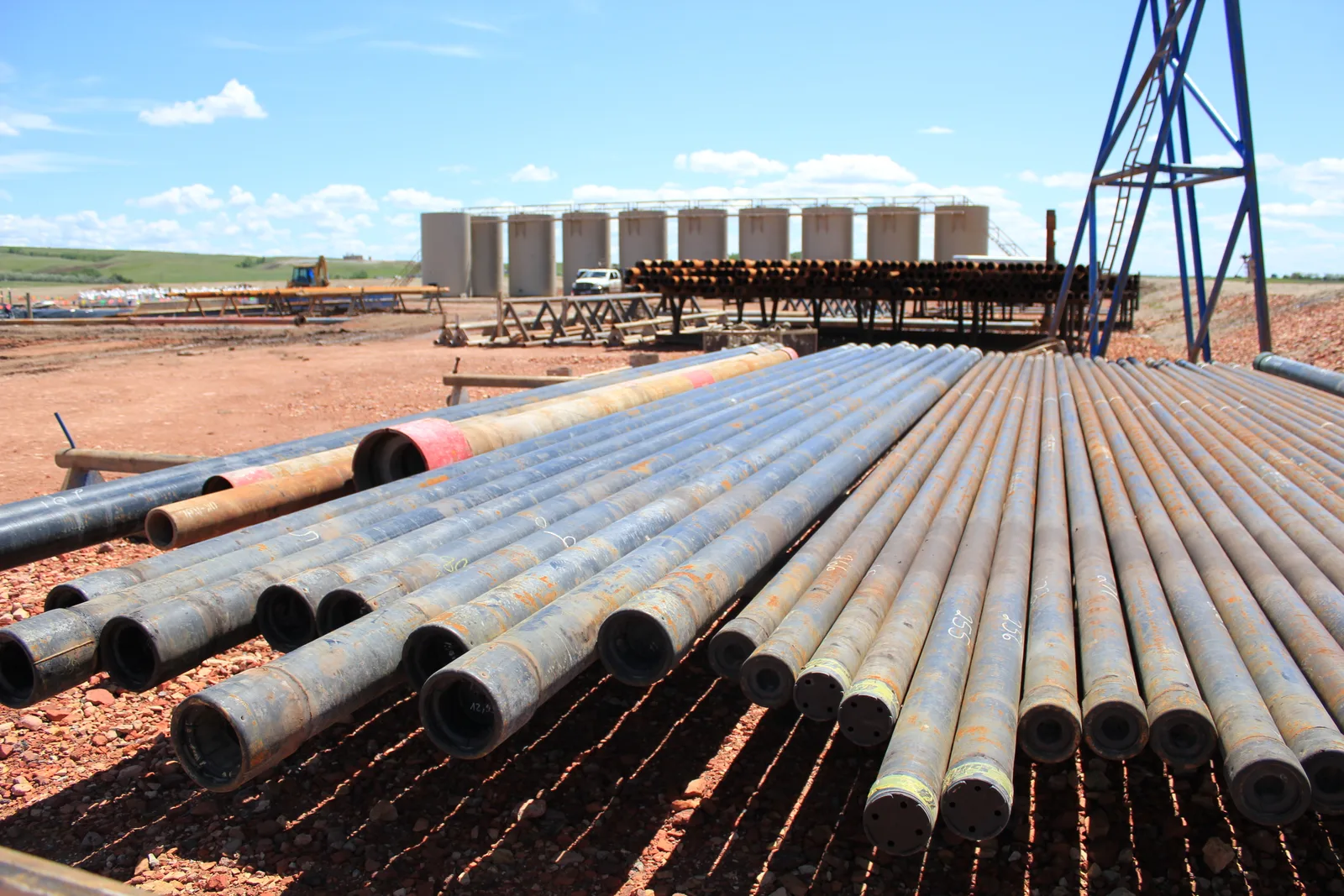
Image: oilfield tubulars racked at a wellsite yard in Williston, North Dakota — the kind of OCTG and line-pipe tonnage whose Gulf deliveries now route through bypass ports or wait out the strait. Credit: Lindsey G (Wikimedia Commons); licence CC BY 2.0; original file page. Resized and converted for this page; illustrative only and unrelated to any specific consignment.
Export offers have fallen for three straight weeks
The pricing series is unambiguous. Mysteel’s weekly international pipe round-up records Tianjin-port FOB offers for the benchmark Φ114.3×6.02 mm ASTM A106B seamless pipe at USD 609 per tonne as of 30 October, down from USD 613 a week earlier. Tube1.cn’s industry weekly had the same specification at USD 616 per tonne as of 16 October. Three sessions of weakness in a row amount to a USD 7 per tonne slide in two weeks — modest in percentage terms, but in the wrong direction while Middle East oil-and-gas pipe enquiries hold relatively steady: tube1.cn notes enquiries from the region are stable, yet “Hormuz transit disruptions continue to suppress actual transactions”. In other words, demand interest survives; closing it does not.
The volume picture behind those offers is still expansionary. General Administration of Customs data relayed by Mysteel put September seamless pipe exports at 572,500 tonnes, up 6.61 percent month on month and 4.95 percent year on year, with January–September exports at 4.539 million tonnes, up 0.78 percent. Surplus domestic supply keeps flowing toward export markets even as freight and war-risk premiums rise — the arithmetic that pushes FOB offers down while delivered costs climb.
Hengyang and Nanjing Steel both say the Gulf is costing them
Company disclosures now say what the freight indices imply. In an investor-relations record of its 30 October meeting published on 3 November, Huarong Steel stated that Hengyang Valin Steel Pipe — one of China’s largest seamless tube mills — has an export mix weighted toward the Middle East, and that this year’s geopolitical conflict and rising logistics costs have markedly increased warehousing and logistics costs on overseas order fulfilment, leaving order profitability below expectations; management added that seamless pipe export margins would recover if the situation eases and logistics and customs conditions improve. A week earlier, Nanjing Steel told institutions on 22 October that its export markets span the Middle East, Southeast Asia and Europe, that some Middle East projects had been affected by the geopolitical conflict, and that it still regards the region as strategically important with demand expected to recover gradually.
The same pressure is visible on the supply side of the OCTG market. Hunting PLC’s Q3 trading update of 28 October said OCTG and other product-line tender activity across the Middle East “remains challenged at present by logistical issues and continued attacks on shipping and regional infrastructure”, alongside a cut to its FY2026 EBITDA guidance to USD 128–133 million. Kuwait Oil Company’s re-tender, published 12 October, is expected to be decided before year-end with shipments from H2 2027 — tender clocks are running, but delivery risk is being priced at a premium. These are company-specific statements, not a sector-wide statistic; but two Chinese mill groups and a UK-based OCTG supplier describing the same logistical drag within a fortnight is as close to corroboration as publicly available sources currently offer.
Domestic market: heavy supply, soft prices
Inside China the story is unchanged: too much pipe, too little demand. Mysteel’s latest weekly survey shows output at 32 sample seamless mills at 422,900 tonnes, up 13,600 tonnes week on week, with mill inventories at 925,800 tonnes — still breaking recent-year highs. Lange Steel put the national average offer for 108×4.5 mm grade-20 pipe at RMB 4,200 per tonne on 2 November, against Mysteel’s 4,238 yuan national average recorded on 30 October. A Liaocheng (Shandong) orange pollution alert issued at noon on 1 November — the city’s pipe plants with a single line fully stopped, multi-line plants keeping one running, an estimated 30,000-tonne output impact according to Lange’s trade survey — offers only local, temporary relief in a market where capacity utilization remains near 85 percent.
Macro demand is softening too: the NBS reported October’s manufacturing PMI at 49.3, down 0.8 points, with the new-orders sub-index at 49.4 — the second dip in four months. Crude has also cooled, with WTI falling more than 4 percent to USD 99.85 and Brent 3.89 percent to USD 109.02 on 2 November after October’s geopolitical spike, trimming the energy-price signal that supports OCTG pricing.
What buyers should do now
For Gulf-bound volumes, quote and contract around the strait as it is, not as talks suggest it might become: lock dated all-in oceanfreight quotes that itemize war-risk and Hormuz-related surcharges, allow extra transit time for bypass routings through Fujairah, Khor Fakkan or Salalah, and treat delivery-to-Dammam or Jebel Ali as a cost-plus exercise rather than a fixed-price commitment. Compare specifications on our API 5L line pipe and casing and tubing pages, and review the documentation set against our shipping-from-China checklist before fixing November programs. If a tender decision such as KOC’s lands in December, expect winning suppliers to price H2 2027 shipments with the current insurance and routing regime in mind. And watch the FOB series: three down-weeks at Tianjin mean Chinese mill margins, not Gulf demand, are absorbing the logistics premium — a window worth using while it lasts.
Sources
- Xinhua (via Sina News) — IMO still advises ships not to transit Hormuz (3 November 2026)
- Jimu News / CCTV (via 163.com) — IMO: ~30 attacks in October, ~400 vessels and 6,000 seafarers stranded (3 November 2026)
- Mysteel — International pipe highlights, week of 24–30 October (30 October 2026)
- Mysteel — Export price and customs data, week of 16–23 October (23 October 2026)
- Tube1.cn — Pipe industry weekly, 15–22 October (22 October 2026)
- Huarong Steel — 30 October investor-relations record, part 2 (published 3 November 2026)
- Nanjing Steel — Investor-relations record 2026-004 (23 October 2026)
- Hunting PLC — Q3 2026 trading update, RNS 6976A (28 October 2026)
- Lange Steel (via Sina Finance) — Liaocheng curbs and 2 November domestic prices (2 November 2026)
- Mysteel — Morning report, 2 November 2026 (2 November 2026)
- Mysteel — Northwest seamless pipe review (30 October 2026)
- National Bureau of Statistics — October 2026 PMI (31 October 2026)
- Securities Times (via 163.com) — WTI falls below $100 (2 November 2026)