EU seamless tube quota: China's Q4 duty-free volume gone in days
China’s duty-free access to the European Union’s “other seamless tubes” category for the fourth quarter of 2026 was effectively over within the first week of October. Quota-tracking data reported by Eurometal on 26 October show the category 24 quota for Chinese-origin material fully exhausted, with registrations dated 8 October receiving a 0 percent allocation, and market analysis putting the effective duty on the first tranche of clearances at about 22.53 percent rather than the advertised 50 percent. For the remainder of the quarter, which runs to 31 December, Chinese seamless tube entering this category faces the full out-of-quota duty plus CBAM costs — yet the landed-cost maths can still undercut EU domestic offers.
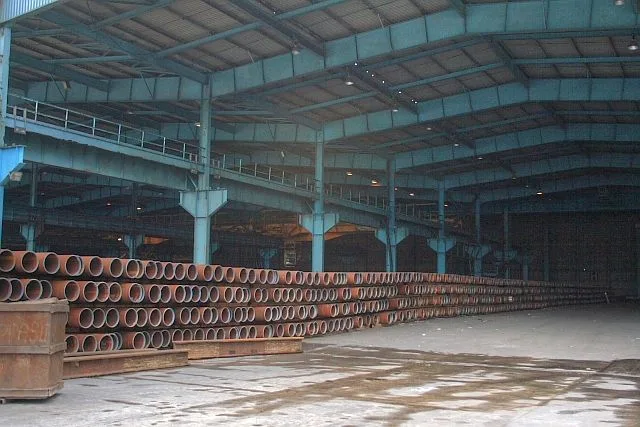
Cover photo: steel pipes stacked in a covered terminal at Teesport, awaiting export. Credit: Mick Garratt (Wikimedia Commons); licence CC BY-SA 2.0; original file page. Resized and converted for this page; the photograph is illustrative and is not connected to any named trader, shipment or quota transaction.
The quota was gone in the first week
Eurometal’s report, drawing on Dow Jones Energy sources, states that checking the EU’s online quota tracker through TARIC shows China’s category 24 quota — the “other seamless tubes” category, with an annual duty-free allowance of 52,635.36 tonnes for Chinese-origin imports, or 13,158.84 tonnes quarterly — fully exhausted, and that the last in-scope volumes dated 8 October received a 0 percent allocation. Commission quota data reported separately by SMM and Delinzl show that within the first five days of the quarter, quotas for China had already been breached across electrical sheet, metallic coated sheet, other seamless pipes and non-alloy wire, with Turkey, India, Australia, Taiwan, North Macedonia and “other countries” also overrunning multiple categories. These events took place in early October; the reporting above is dated 6–26 October, and this article adds the quarter-wide picture and the buyer impact rather than a same-day bulletin.
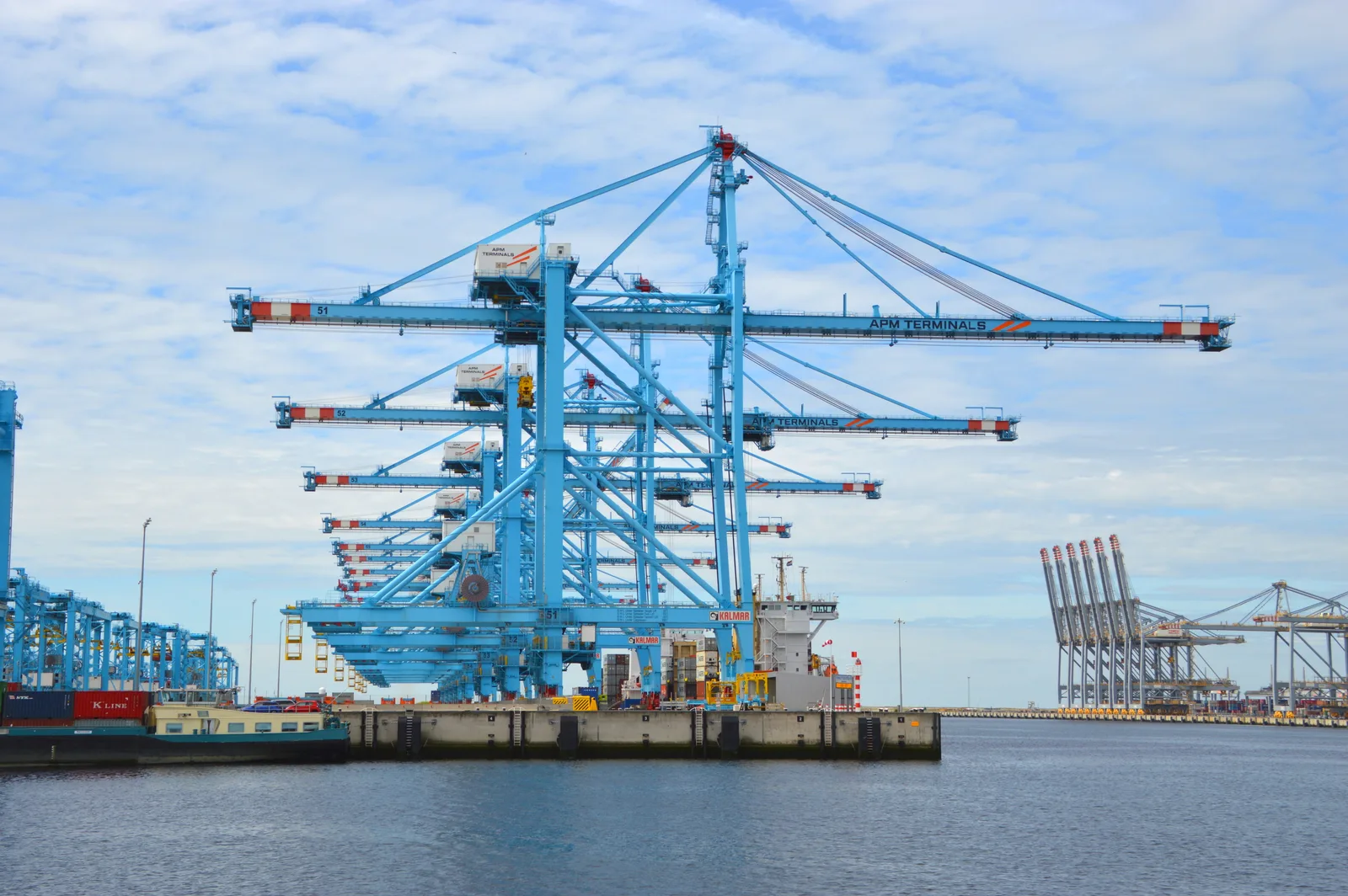
Image: APM Terminal gantry cranes at Maasvlakte, Rotterdam — the bloc’s largest import gateway. Credit: Spielvogel (Wikimedia Commons); licence CC BY-SA 4.0; original file page. Resized and converted for this page; illustrative only and unrelated to any specific consignment.
How a 50 percent duty became 22.53 percent
The European Steel Tube Association’s weekly quota report of 2 October, cited by Eurometal, recorded 23,948 tonnes awaiting allocation against an initial quarterly balance of 13,159 tonnes — nearly double the allowance. Because the EU allocates first-come-first-served quotas pro rata across pending clearances rather than refusing the excess, the 50 percent out-of-quota duty was spread across the whole 23,948 tonnes, producing an effective duty rate of 22.53 percent. Peacock Tariff Consulting’s analysis of 26 October works through the same arithmetic and reaches the same 22.53 percent figure; its figures trace to the same ESTA and Dow Jones data, so the two texts should be read as independent write-ups of one dataset rather than two confirmations. The dilution is not a loophole that regulators have overlooked — it is written into how EU tariff-rate quotas are administered — but steelmakers told Eurometal it lets more imports in at lower cost than the tightened quotas were designed to allow.
Landed cost still undercuts EU offers
On prices, Eurometal reports import offers for Chinese seamless tube at EUR 568 per tonne FCA and EUR 768 per tonne CIF. Applying the diluted 22.53 percent duty and roughly EUR 130 per tonne of CBAM cost gives a landed value of about EUR 1,071 per tonne, against EU domestic offers of about EUR 1,350 per tonne for equivalent goods — almost EUR 300 per tonne below local pricing. Peacock’s note makes the uncomfortable corollary explicit: even applying the full 50 percent duty to the CIF price leaves the landed cost roughly EUR 100 per tonne below the EU offer. Volume control, in other words, is currently doing more work than price deterrence in this category.
The regime behind the numbers
The rules come from Regulation (EU) 2026/1384, in application since 1 July 2026: the first 18.3 million tonnes of steel per year enter duty-free, volumes above the quota carry a 50 percent ad valorem duty, up from 25 percent under the previous safeguard, according to EUROFER. Since 1 October 2026 importers must also document the country where the steel was melted and poured, with mill test certificates as the primary evidence and melt-and-pour data due to feed into quota allocation from October 2027; Baker McKenzie’s client alert sets out the timeline. Two review tracks matter next: the Commission must decide by 31 December 2026 whether to extend the regime to four further product groups including cast-iron tubes, and it ran a targeted consultation on the first quarter’s implementation between 28 September and 11 October, which SMM reported could influence later quota adjustments. Peacock’s quota-dilution note also flags that China generally has no fallback access to the residual quota pool once its country-specific allocations are consumed, which is why the category 24 exhaustion was a hard stop.
What it means for Chinese exporters and EU buyers
For the rest of Q4, every tonne of Chinese seamless tube cleared in category 24 pays the 50 percent out-of-quota duty on top of CBAM costs — the duty-free window that diluted the rate in early October is closed until the next quarterly reset. This stacks onto an already dense wall of measures around Chinese tube exports: India’s DGTR recommended on 23 October that the 0–268 USD/tonne duty on Chinese seamless pipes and hollow profiles run for another five years (SteelOrbis; Jiangsu fair-trade platform, covered in our report on India’s sunset review), and the Eurasian Economic Commission extended its OCTG duties on China to October 2031 and removed Hunting Energy Services (Wuxi) from the price-undertaking list, effective 30 days after its 9 October notice, per Sichuan’s commerce department. Buyers of carbon pressure and line grades can compare specifications on our ASTM A106 carbon steel pipe and API 5L line pipe pages; the melt-and-pour documentation requirement is a natural extension of the mill test certificate checks importers already run.
What buyers should do now
Treat the quarter’s quota state as a cost input, not a surprise at clearance: model landed cost with the full 50 percent duty plus CBAM rather than the diluted early-October rates, keep entry records aligned with the written scope, and request MTCs that state the melt-and-pour country. Where Q4 delivery is fixed, check whether in-quota volumes from other origins with remaining balances offer a viable substitution before repricing Chinese volumes. The first-week exhaustion and the pro-rata controversy are also a signal that the Commission’s monitoring and the 31 December scope review could tighten the regime further — worth tracking before locking in Q1 2027 volumes.
Sources
- Eurometal — EU steelmakers take aim at pro-rata TRQ duty dilutions (26 October 2026)
- Peacock Tariff Consulting — Quota Leak (26 October 2026)
- Peacock Tariff Consulting — Quota Dilution (26 October 2026)
- Delinzl — EU fourth-quarter steel import quotas overrun within five days (9 October 2026)
- SMM — EU Q4 steel quotas exhausted at the opening (6 October 2026)
- SMM — EU Q4 quota analysis and Commission consultation (7 October 2026)
- European Commission — Targeted consultation on the first product scope review under the EU Steel Regulation
- EUROFER — EU trade measure saves steel industry from cliff edge (14 April 2026)
- Baker McKenzie — New EU steel trade defence regime (22 September 2026)
- SteelOrbis — India’s DGTR recommends five-year AD duty on Chinese seamless pipes (29 October 2026)
- Jiangsu Fair Trade Platform — India second sunset review final finding (30 October 2026)
- Sichuan Commerce Department — EAEU extends OCTG duties on China to 2031 (23 October 2026)