Kuwait OCTG re-tender awaits award as Saudi rigs slow Jafurah
On 28 October 2026, Hunting PLC cut its full-year 2026 EBITDA guidance to $128-133 million (from $138-141 million) because the conflict in the Middle East has stalled oil country tubular goods (OCTG) tendering across the region. In the same update, the company confirmed that Kuwait Oil Company’s large OCTG re-tender — published on 12 October — should be awarded before the end of 2026, with product shipments starting in the second half of 2027. Rig activity in Saudi Arabia has declined, reducing work on the Jafurah unconventional gas development. For seamless pipe producers and exporters, the message is that project spending in the Gulf continues while well-completion-linked OCTG orders slip to the right.
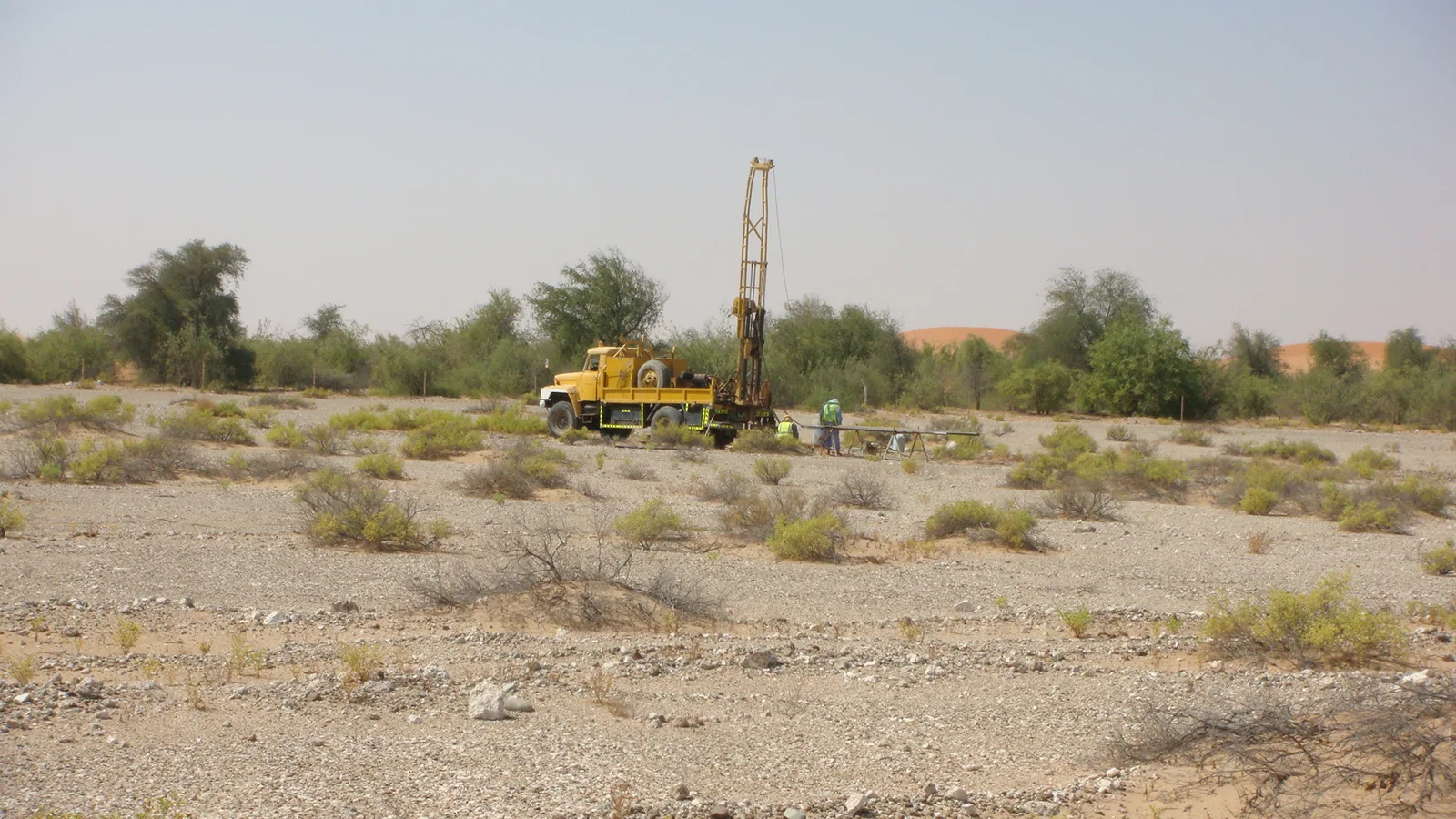
Cover image: truck-mounted drilling rig operating on desert gravel in the Gulf region. Credit: Fadi Fayad Al Taoba (via Wikimedia Commons), CC BY 3.0, source file page; license CC BY 3.0. Illustrative photo only, scaled and converted to WebP; not a picture of a well site named in this article.
Hunting cuts 2026 guidance on Middle East disruption
Hunting’s trading update is blunt about the cause. “The ongoing conflict in the Middle East and some slowing of activity across other markets mean that the Group’s anticipated EBITDA outturn is now likely to be in the range of $128-$133 million for the full year,” the company said in its outlook statement. Year-to-date EBITDA stood at about $89 million with a margin of roughly 12%, and Proactive Investors reported that third-quarter EBITDA of about $27 million was down from $39 million in the second quarter, with the shares falling about 11% in London trading. Corporate Finance News noted this is the second guidance cut this year. The OCTG product group sits directly in the path of the disruption: Hunting said deliveries to the Middle East slowed noticeably since the start of the quarter, and it expects a further OCTG slowdown in North America in Q4.
Kuwait’s KOC re-tender: award before year-end, shipments from H2 2027
The most concrete procurement datapoint in the update concerns Kuwait. Hunting confirmed that “the large Kuwait Oil Company (‘KOC’) re-tender was published on 12 October 2026” and that a decision is anticipated before the year-end, with product shipments due to commence in H2 2027. Corporate Finance News reported the same timing, and Proactive Investors added that investors are awaiting the outcome with results expected towards the end of the year. KOC’s own tender documents are not publicly accessible, so the timeline rests on Hunting’s regulatory statement — a primary source — corroborated by two independent financial outlets. For OCTG mills, an award before year-end with shipments from mid-2027 means the volume lands late in the 2027 delivery window, not in early 2027 as previously hoped.
Two tubular suppliers confirm the OCTG stall
The demand signal is not one company’s reading. Alleima — the Swedish seamless stainless and special-alloy tube maker — published its Q3 2026 report on 26 October stating that “after more than eight months of crisis in the Middle East and a largely stalled OCTG market, we saw an increasing negative impact on the oil and gas segment within the Tube division,” including the cancellation of an OCTG order worth about SEK 250 million. One day later, Hunting described OCTG and other product-line tender activity across the region as “challenged at present by logistical issues and continued attacks on shipping and regional infrastructure.” Two independent listed companies, reporting within 48 hours of each other, describe the same stalled market — that is the strongest available confirmation that Middle East OCTG demand, which is predominantly seamless, is being deferred rather than lost.
Saudi projects keep moving: offshore awards and the Master Gas System
Project spending tells a different story from well completions. According to industry press, Saudi Aramco issued five offshore contract release and purchase orders (CRPO 167-171) worth up to $2.5 billion in total for maintenance and brownfield work on the Marjan, Zuluf, Abu Safah and Safaniya fields — eight jacket structures and 13 production deck modules — with Abu Dhabi’s NMDC Energy confirming three packages worth about AED 2.8 billion ($763 million) in a 23 October disclosure to the Abu Dhabi Securities Exchange (MEED, OrePulse). On the midstream side, EnterpriseAM reports Aramco is spending $8.8 billion on Phase III of its Master Gas System — roughly 4,000 km of pipelines and 17 gas compression trains adding 3.1 bcf/d of transmission capacity by 2028 — while Jafurah’s processing facilities are being built in phases, with phase one complete and phase two under a $2.3 billion award.
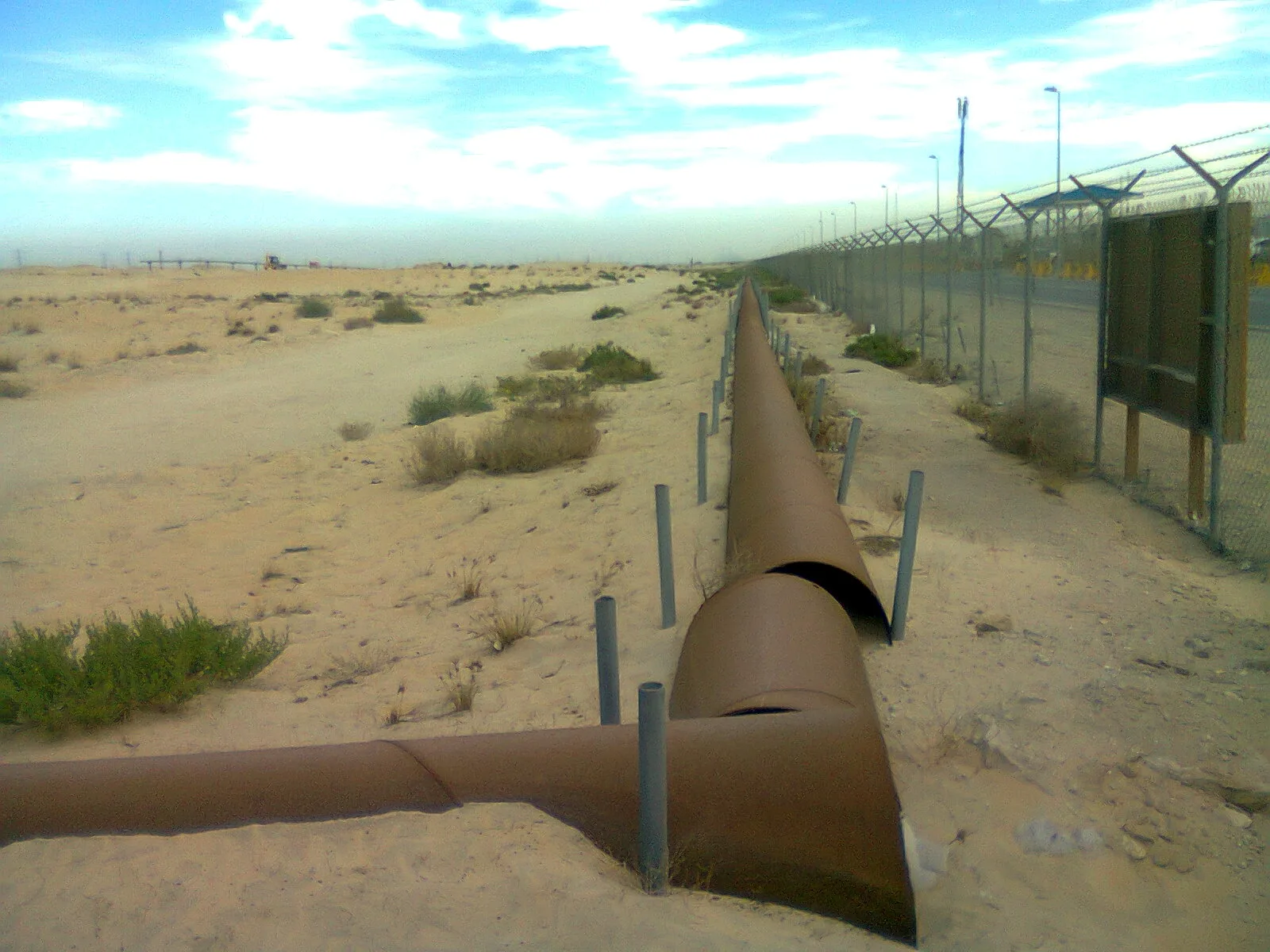
Above: large-diameter surface pipelines in the Jubail desert, Saudi Arabia. Credit: Suresh Babunair (via Wikimedia Commons), CC BY 3.0, source file page; license CC BY 3.0. Historical photo (2012), scaled and converted to WebP; illustrative of Gulf transmission lines, not a project named in this article.
Buyers should keep the product split straight: these trunk lines and station spools are predominantly welded line pipe, and recent orders reflect that — India’s Welspun Corp won a $580 million coated line pipe order for a Permian Basin gas pipeline serving a data-center complex, with deliveries in fiscal 2028-29 (SteelOrbis). Seamless demand in these programs concentrates in OCTG, station and manifold piping, and high-specification components — see our explainer on seamless versus welded steel pipe and our line pipe range for the boundary conditions.
What it means for seamless pipe buyers
Three practical takeaways for procurement teams buying OCTG and seamless line pipe into the Middle East and Asia-Pacific. First, tender timing, not demand destruction: the KOC re-tender is live and other regional tenders are being re-sequenced, so quote validity and delivery-slot flexibility matter more than headline price. Second, inventory overhang: Alleima’s cancelled order and Hunting’s slowing deliveries point to elevated upstream inventories, which typically pressures prices for standard-grade casing and tubing while premium connections hold up better. Third, the oil-price floor remains: the US Energy Information Administration raised its fourth-quarter 2026 Brent forecast to an average of $105 per barrel, citing attacks on Saudi Arabia’s East-West pipeline among the volatility drivers, and China’s September crude output rose 2.2% year on year while refinery runs fell 8.4% (NBS) — a reminder that upstream activity and downstream demand are moving out of sync. Our 2026 industry trends review tracks how these threads connect for pipe buyers.
Sources
- Hunting PLC — Q3 2026 Trading Update (RNS via ACCESS Newswire, 28 October 2026)
- Proactive Investors — Hunting shares fall 11% as Jefferies flags weaker Middle East and North American activity (28 October 2026)
- Corporate Finance News — Hunting cuts earnings forecast on Middle East conflict (28 October 2026)
- Alleima AB — Q3 2026 interim report (26 October 2026)
- EnterpriseAM — Saudi Arabia is building its gas business at home and its LNG business abroad (27 October 2026)
- MEED — Aramco selects contractors for five offshore tenders (23 October 2026)
- OrePulse — Aramco awards $2.5bn in offshore deals for four Saudi oil fields (27 October 2026)
- SteelOrbis — Welspun Corp bags $580 million worth order for supply of coated line pipe in US (26 October 2026)
- U.S. EIA — Short-Term Energy Outlook, October 2026
- National Bureau of Statistics of China — 2026年9月份能源生产情况 (19 October 2026)