India keeps $268/mt duty on Chinese seamless pipe for five years
India’s Directorate General of Trade Remedies recommended on 23 October 2026 that the anti-dumping duty on seamless tubes, pipes and hollow profiles from China be fixed at USD 268 per tonne and run for another five years, replacing the minimum-price mechanism that has governed this case since 2017. The final findings in Case No. AD (SSR)-04/2026 also curtail the product scope: oil country tubular goods, which earlier duty lines covered, are excluded from this review. Because the measure now in force was extended to 27 January 2027, the recommendation reaches exporters before the levy lapses, and it lands in the same week that Washington opened its own case against Indian pipe. This is the third act of a case opened in 2015, and for buyers in India it changes the arithmetic of a quotation rather than the existence of a duty.
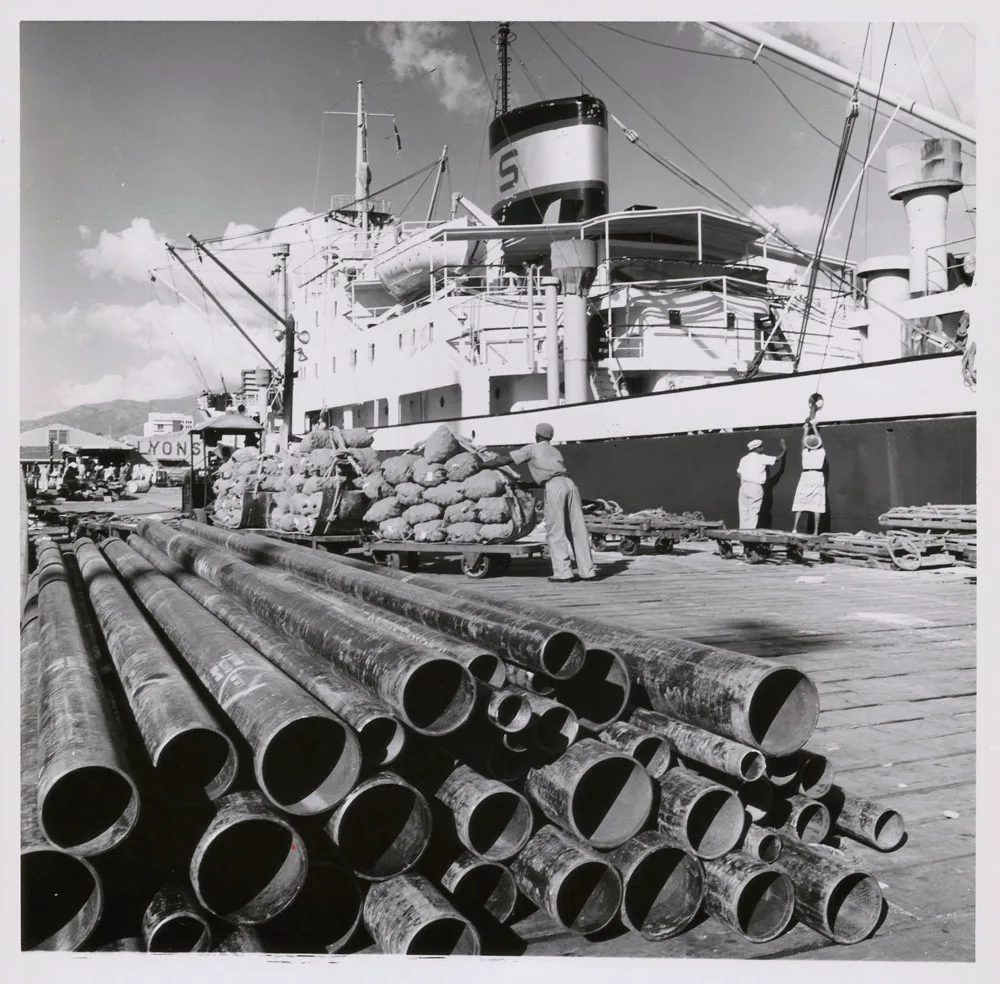
Cover photo: steel pipe stacked on a quayside while cargo is unloaded from a freighter at Kingston, Jamaica, an archival photograph from Library and Archives Canada, resized and converted for this page. Credit: BiblioArchives / Library and Archives Canada (Wikimedia Commons); licence CC BY 2.0; original file page. The photograph is illustrative and is unrelated to the proceedings described here.
What the 23 October findings recommend
The final findings follow a sunset review that three Indian producers — Jindal Saw Limited, Kirloskar Ferrous Industries Limited and Maharashtra Seamless Limited — requested to keep the duty alive. DGTR concluded that dumping and injury would likely continue or recur if the measure expired, and that “it is deemed appropriate to recommend a fixed form of anti-dumping duty”. The operative paragraph recommends a duty “equal to the amount indicated in Column (7) of the duty table given below … on all imports of the product under consideration, from the subject country for a further period of five (5) years”.
The table sets three lines. Jiangsu Chengde Steel Tube Share Co. Ltd receives NIL. Any other producer in China PR pays USD 268 per tonne, and the same USD 268 applies where the country of export is any country other than China PR — the clause that closes the third-country routing that the United States has pursued through separate proceedings. The nil rate is not automatic: paragraph 129 makes it conditional on a dated, signed declaration on the commercial invoice identifying the issuing entity and certifying the goods.
The change of form is the substance. Under the 2017 and 2021 notifications the duty was the gap between the declared landed value and a reference price band of USD 961.33 to 1,610.67 per tonne, so a shipment priced above the reference paid nothing. The findings record why that stopped working: exporters were “declaring an export price which is marginally higher than the benchmark determined by the Authority, in order to avoid paying the anti-dumping duties”, while the same findings put actual offers at USD 650-850 per tonne, well below the non-injurious price. A flat USD 268 cannot be priced around in the same way, and on a USD 650-850 offer it is roughly a third to two-fifths of the goods value before freight.
DGTR measured the injury on a market that grew anyway. Demand rose 23% over the injury period while subject imports rose 53% and the applicants’ sales rose 17%; the three applicants account for 93% of Indian production and ran below 50% of installed capacity throughout. Dumping margins were found at 5-15% for the cooperating exporter and 65-75% for everyone else, over an investigation period of 1 October 2024 to 30 September 2025. One caution on reading the file: the isrgrajan summary of 25 October examined a partial copy of the document and correctly said it could not find a rate, so the amount has to be taken from the notice and from reporting that saw the full text, such as SteelOrbis.
Why 27 January 2027 is the date that matters
A recommendation is not a levy. DGTR forwards the findings to the Department of Revenue in the Ministry of Finance, which issues the customs notification that actually collects the duty; until that notification appears, the 2021 measure remains the operative instrument. The findings fix the calendar: pending this review, “the duties have been extended for a period of 3 months, vide Notification No. 16/2026-Customs (ADD), dated 6th July 2026”, and “the duties are now set to expire on 27th January 2027”. SteelOrbis reported the same date on 29 October.
That date matters because a large part of the Chinese-language coverage still circulates the old one. The compilation published by Anhui’s provincial commerce department on 26 October, like the versions carried by the Cailian Press wire and several portals, repeats the 2021 wording that the measure runs to 27 October 2026. Exporters and importers planning around an October expiry would be planning three months early; the file itself says January.
What stays inside the duty and what drops out
The product under consideration is seamless tube, pipe and hollow profile of iron, alloy or non-alloy steel, hot finished, cold drawn or cold rolled, with an external diameter not exceeding 355.6 mm (14 inches), other than cast iron and stainless steel, under heading 7304. The findings describe it as including “boiler pipes or line pipes used in hydrocarbon industry”. Those are the lines this site supplies as API 5L line pipe and ASTM A106 carbon steel pipe, and they remain inside the duty.
Oil country tubular goods do not. The conclusion states that “the scope of the product under consideration has been curtailed in the present investigation and whereas duties were earlier in force on imports of Oil Country Tubular Goods (OCTG) covered under PCNs A-1-1 to A-1-4, the same has been excluded from the scope of the duty in the present review”. For casing and tubing buyers, the carve-out only bites when the new notification takes effect; while the 2021 instrument remains in force, the earlier treatment still governs, so an Indian customer should confirm which notification their customs broker is applying on the day of entry rather than assuming the findings date is the switch date.
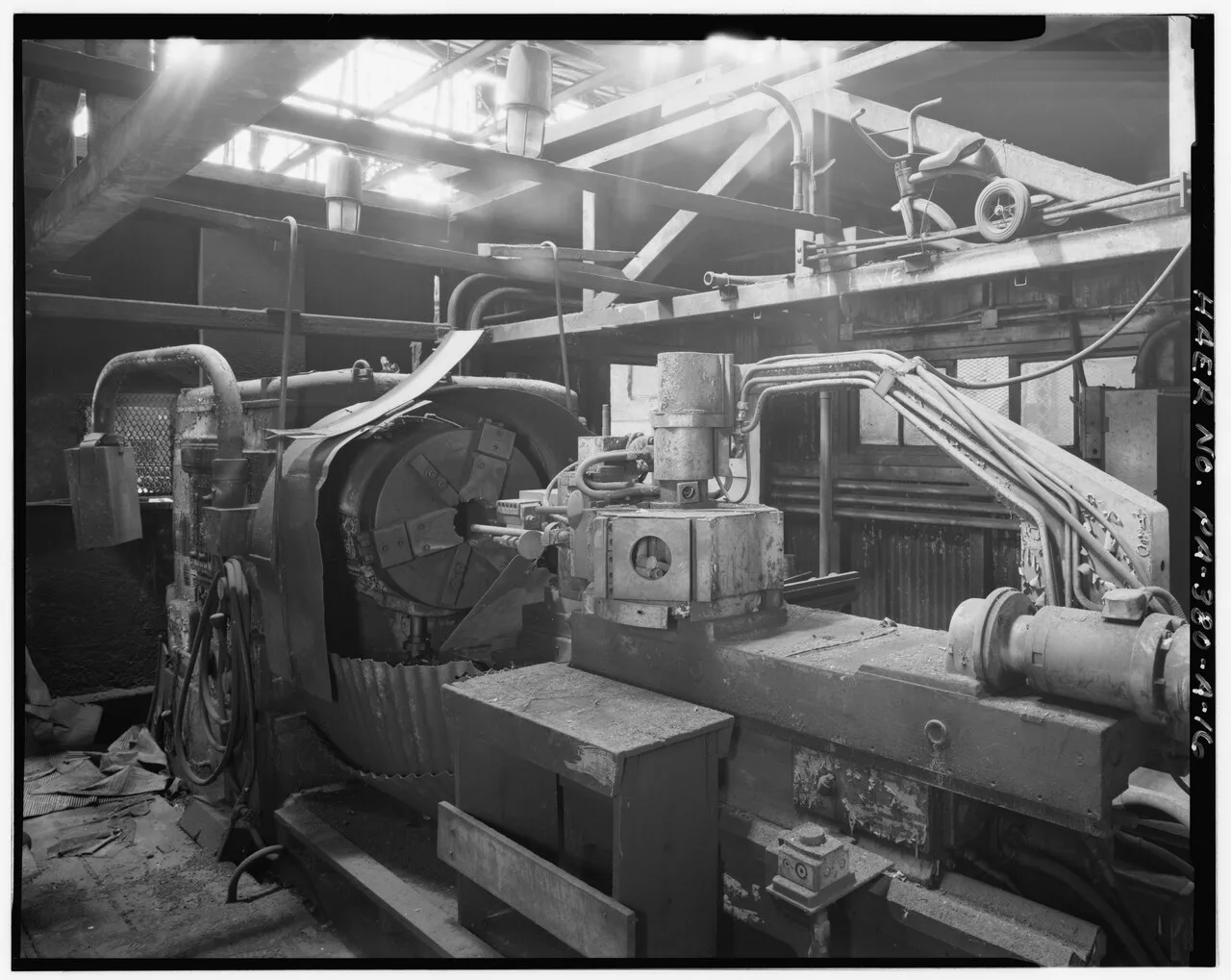
Body photo: the threading machine on the No. 1 seamless line at the National Tube Works, McKeesport, Pennsylvania, recorded for the Historic American Engineering Record; casing and line pipe are threaded after the tube is formed. Resized and converted for this page. Credit: Martin Stupich / Historic American Engineering Record; licence public domain mark; original file page. The photograph is archival and unrelated to the Indian proceeding.
The same week: Washington turns to Indian and Georgian pipe
Friday’s wider picture is that the trade measures are moving in opposite directions at once. On 20 October the U.S. International Trade Commission instituted investigations 701-TA-810 and 731-TA-1811-1812 on seamless carbon and alloy steel standard, line and pressure pipe from Georgia and India, with a preliminary determination due by 30 November and views to Commerce by 7 December; we set out the scope and the petition in the 21 October report. One day later, Commerce continued the oil country tubular goods orders against India, Korea, Türkiye, Vietnam and Ukraine from 29 September, which we covered in the 23 October weekly review.
Read together, the two records and the Indian findings describe a market where the same producer can be a complainant at home and a respondent abroad within four days. India’s seamless producers are protected on standard pipe up to 14 inches and, from the new notification, no longer need protection on oil country goods; simultaneously their exports to the United States face a possible AD/CVD case and their casing and tubing exports face duties that are already in place.
The Chinese side of the ledger has not tightened. Customs data reported by Mysteel show September seamless pipe exports of 572,500 tonnes, up 6.61% month on month and 4.95% year on year, with January-September shipments at 4.5388 million tonnes, up 0.78%. Domestic prices are still drifting: the national 108x4.5 mm average was 4,244 yuan per tonne in the week to 23 October, down 13 yuan, with mill stocks at 931,200 tonnes, according to Mysteel’s weekly survey. We described the price and margin picture in the 2026 price guide and in the 28 October report on mill profits.
What this changes for buyers
Three practical points follow. First, an Indian quotation for standard or line pipe now has to be modelled with a fixed USD 268 per tonne on top of the FOB price for every producer except one, so landed-cost comparisons that relied on a reference-price formula are out of date even before the notification appears. Second, the nil line will create a single-origin price advantage; buyers should treat an invoice without the paragraph 129 declaration as exposed to the full rate, because the concession travels with the document, not with the exporter’s name on the packing list. Third, oil country goods are being carved out of the Indian duty at the same time as they are locked into American ones, so a supplier switching between the two markets is now optimising against two different regimes rather than one.
What to watch: the Department of Revenue notification, which sets the effective date and will show whether the government adopts the fixed form as recommended; the ITC’s 30 November preliminary determination on Indian and Georgian pipe; and whether Chinese export offers keep softening, since a weak domestic market is what makes a USD 268 duty survivable for a seller who wants the volume.
Sources
- DGTR final findings, Case No. AD (SSR)-04/2026, 23 October 2026
- SteelOrbis, “India’s DGTR recommends five-year AD duty on Chinese seamless pipes”, 29 October 2026
- U.S. International Trade Commission, institution notice, 91 FR 66358, 20 October 2026
- U.S. Department of Commerce, OCTG continuation notice, 91 FR 66681, 22 October 2026
- Anhui Provincial Department of Commerce, compilation of the Indian final findings, 26 October 2026
- Mysteel, China’s September seamless pipe exports, 20 October 2026
- Mysteel, national seamless pipe price and mill stock survey, week to 23 October 2026