Hainan–Guangdong 524 km gas pipeline enters EIA as new line pipe orders queue up
China’s pipeline builder has put two more long-distance gas lines into the permitting queue. On 5 November, PipeChina’s South China branch published the first environmental impact assessment (EIA) public notice for the Hainan–Guangdong gas pipeline, a 524-kilometre trunk line that will connect Hainan’s island gas network to the mainland grid for the first time (PipeChina). A separate notice the same day opened EIA consultation for the 363-kilometre Tongliang–Zunyi pipeline in southwest China (PipeChina). Both filings sit on top of a construction season in which the national network operator reports major nodes falling into place on projects from northeast China to Xinjiang (Xinhua).
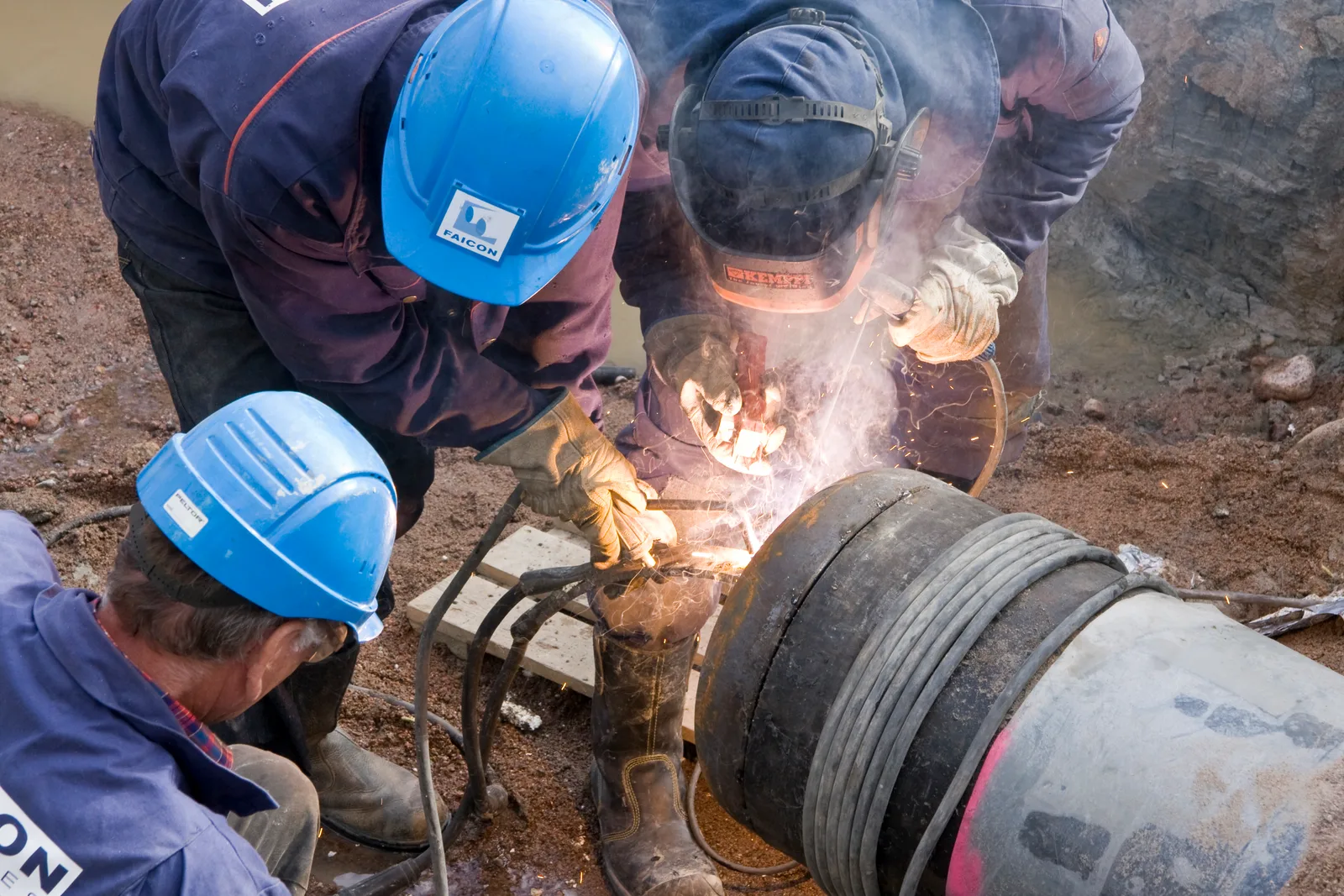
Cover image: welders joining a large-diameter gas pipeline in an open trench. Credit: Jukka Isokoski / Gasum Oy (Wikimedia Commons); license CC BY-SA 3.0; original file page. The version used on this page has been resized and converted; the photo is illustrative only and is not connected to any named project.
What the notice discloses
The first EIA notice states the project’s parameters in unusually concrete terms: a total length of 524 km, of which 430 km is 813 mm pipe and 94 km is 1,016 mm pipe (the section between the Lin’gong liaison compressor station and the Tandou offtake station), a design pressure of 10 MPa, and design send-out of 6.0 billion cubic metres (bcm) per year initially, rising to 8.0 bcm in the long term (PipeChina). The line runs from Wanning on Hainan’s east coast through five Hainan cities and counties and Zhanjiang to Maoming in Guangdong, with 10 stations (three of them compressor stations) and 12 block valve stations along the route (PipeChina). Crossings include one large river drive of 900 m, twelve medium river crossings totalling 8 km, and two shore-to-sea directional drills totalling 3 km.
The design has grown since September
Comparing the two filings shows the scheme is still being optimised. The September social stability risk assessment, published on the Chengmai county government website, described a 530 km line with 65 km of subsea pipe, all in 813 mm diameter, initial send-out of 5.61 bcm per year and total investment of about 10.2 billion yuan (Chengmai County Government). The November EIA version trims total length to 524 km but upgrades 94 km to 1,016 mm and lifts initial capacity to 6.0 bcm per year — a change that matters directly for line pipe sizing and steel grade. Industry media reported in early November that the assessment stage was completed on 12 October and that the project is expected to be ready for construction in the second half of 2027, with the Hainan section at 243 km and five stations (LNG168).
Why Hainan needs a mainland link
Hainan’s island network currently runs 899 km with 14 stations and 42 valve chambers and has delivered more than 35 bcm of gas cumulatively, serving power plants, industry and city gas users across 14 counties and cities (Hainan TV via Tencent News). The Hainan–Guangdong pipeline is the missing interconnection: once built, island demand — including two large gas-fired power plants — can be backed up by mainland and imported gas, and offshore production gains a second outlet. Provincial regulators were on the island this month reviewing 15th Five-Year energy projects including nuclear, gas power and the third and fourth Hainan–Guangdong (power) interconnection links, an indication of how much load growth the province is planning for (NEA Southern Regulation Bureau).
A busy national pipeline queue
The two new filings are not isolated. Xinhua’s 10 November round-up of PipeChina projects reports that the Hulin–Changchun pipeline, built over three years, has completed full-length construction and entered pre-commissioning, with designed annual send-out of 10 bcm; that the second Sichuan-to-East gas pipeline has welded nearly 800 km this year, about 80% of the annual task; and that the Zhundong coal-to-gas export trunk line has passed 94% welding progress (Xinhua). In the southeast, the Fujian section of the Fujian–Guangdong network interconnection started construction this month (Sinopec News via CPPEI). Meanwhile, domestic mills are shipping for the “north gas south” corridor: Sinopec Machinery delivered the first batch of 18-metre super-long pipes for the Daqing–Changling pipeline on 6 November — X80 grade, cutting field girth welds by roughly 30% versus 12-metre pipe (Sina Finance) — and HBIS supplied 5,700 tonnes of low-temperature line pipe steel to the Heihe–Daqing pipeline (HBIS Group). PipeChina also disclosed on 6 November that its redundant-degree-of-freedom pipeline field-welding robot and a network-wide simulation system were listed among the national energy sector’s first-set major technical equipment (PipeChina).
Where seamless pipe fits — and where it does not
Large-diameter trunk lines such as these are welded-pipe territory: spiral or longitudinal submerged-arc pipe in 813, 1,016, 1,219 and up to 1,422 mm at X70/X80 grades carries the mainline tonnes, and API 5L line pipe buyers should read the 10 MPa, 6–8 bcm parameters as the sizing envelope. The seamless share sits at the edges of the system, and that share is written into the notice itself: 10 stations and 12 valve stations on the Hainan–Guangdong line, four stations on Tongliang–Zunyi (PipeChina).
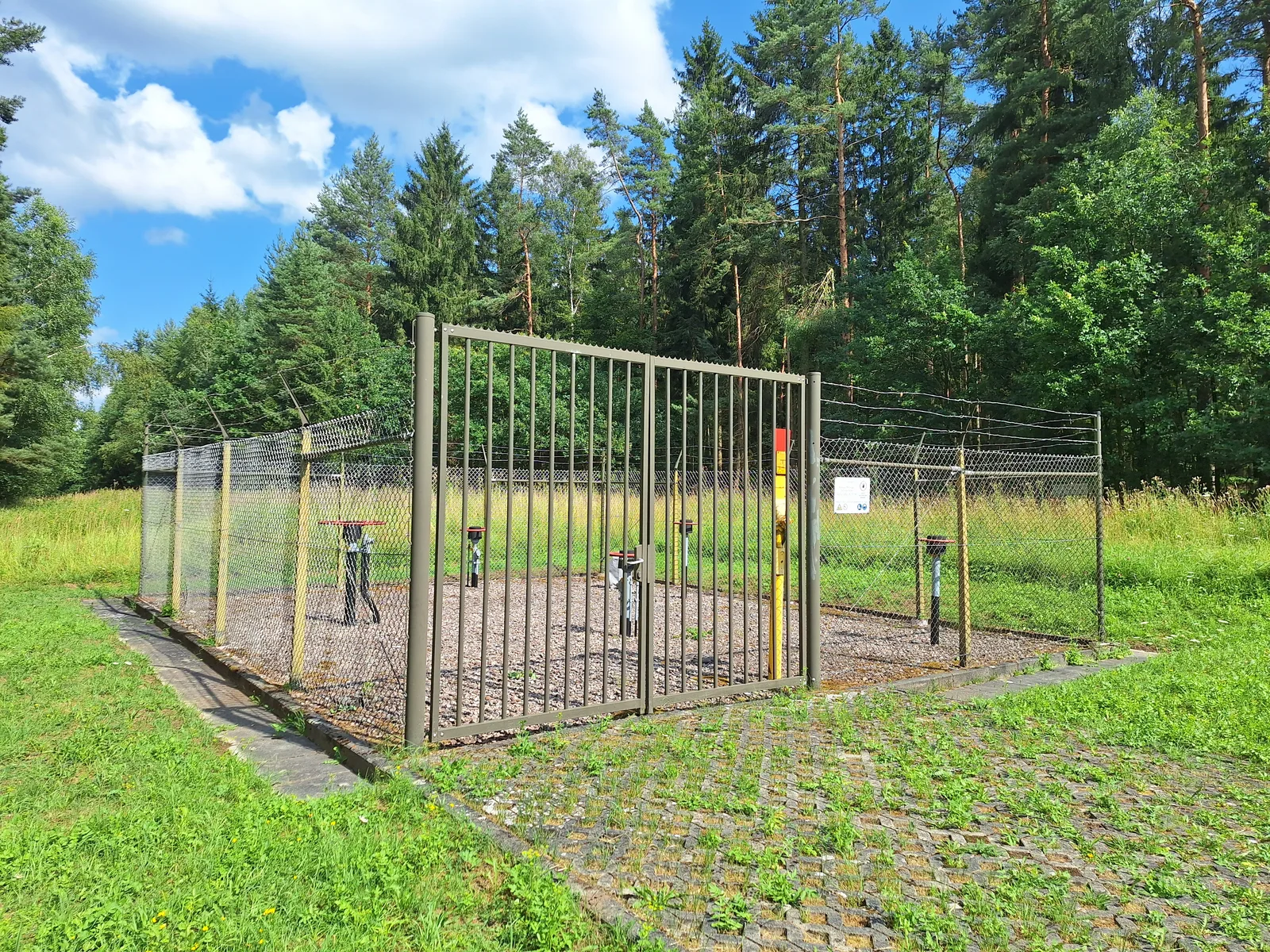
Image: a fenced block valve station on a long-distance gas transmission pipeline — valve stations and above-ground piping are exactly where seamless pipe and fittings concentrate. Credit: Steffen Mokosch (Wikimedia Commons); license CC BY-SA 4.0; original file page. The version used on this page has been resized and converted; the photo is illustrative only and is not connected to any named project. Compressor-station process piping, metering and pressure-regulation skids, fuel and seal-gas lines, and city-gate and industrial offtake connections are typical ASTM A106 carbon steel pipe and alloy-tube scopes, and the valve stations that dot the right-of-way are fabricated from seamless pipe and fittings. Our overview of seamless pipe in oil and gas pipelines maps this split in more detail. The spot backdrop is soft — Lange’s 11 November survey had Shenyang seamless prices flat, with buyers ordering in small lots as outdoor work winds down (Lange via Sina Finance) — so project station packages are exactly the kind of demand that stands out.
What pipe buyers should watch
The sequence from here is EIA report approval, then central government approval, then pipe procurement tenders. The Hulin–Changchun and Sichuan-to-East projects show the pattern: trunk pipe orders concentrate in the first construction season, while station piping, fittings and valve-station packages are released as stations are detailed. For the Hainan–Guangdong line, the stability assessment reported readiness for construction in the second half of 2027 (LNG168), which puts tendering windows in the intervening quarters. Buyers quoting into these projects should track the 813 mm versus 1,016 mm split (the November change), X70/X80 grade requirements on the mainline, and PSL2 plus low-temperature requirements for any station scope in the north.
Sources
- 琼粤天然气管道环评公众参与第一次公示 — 国家管网集团
- 铜梁—遵义天然气管道项目首次生态环境影响评价信息公开 — 国家管网集团
- 琼粤天然气管道社会稳定风险评估公示 — 澄迈县人民政府
- 琼粤天然气管道项目稳评公示完成 前期工作有序推进 — LNG168物联网
- 超350亿立方米 从C到O闭环! — 海南新闻联播(腾讯新闻)
- 国家管网集团油气基础设施建设提速 — 新华网
- 铜梁—遵义天然气管道启动首次环评信息公开 — 中国能源产业发展网
- 石工建江苏油建公司承建国家管网重点工程开工 — 中国石化报(中国石油石化工程信息网)
- 推进新型能源基础设施建设 — 人民论坛网
- 首批18米超长钢管启运!服务“北气南下”能源通道 — 新浪财经(转中国石化机械)
- 集团高端管线钢直供国家石油天然气发展“十五五”规划项目 — 河钢集团
- 沈阳无缝管价格暂稳 工程采买节奏放缓 — 兰格钢铁(新浪财经转载)
- 南方能源监管局赴海南开展2026年能源规划目标任务实施情况监管 — 国家能源局南方监管局
- 国家管网集团两项成果入选能源领域首台(套)重大技术装备清单 — 国家管网集团