China seamless pipe output falls for a second week as maintenance wave builds
China’s seamless tube mills cut output for a second consecutive week in the week of 5–11 November, and two independent survey houses recorded the same direction: Mysteel’s 30-mill sample fell to 386,500 tonnes with the operating rate down to 68.32 percent, while Lange Steel’s separate national survey put the composite operating rate at 70.12 percent. The contraction is being driven by heavy-pollution emergency curbs across Hebei and Shandong plus a cluster of planned overhauls — but the official weather outlook says the smog driver should fade in the second half of November, which puts the burden on maintenance schedules rather than air-quality rules.
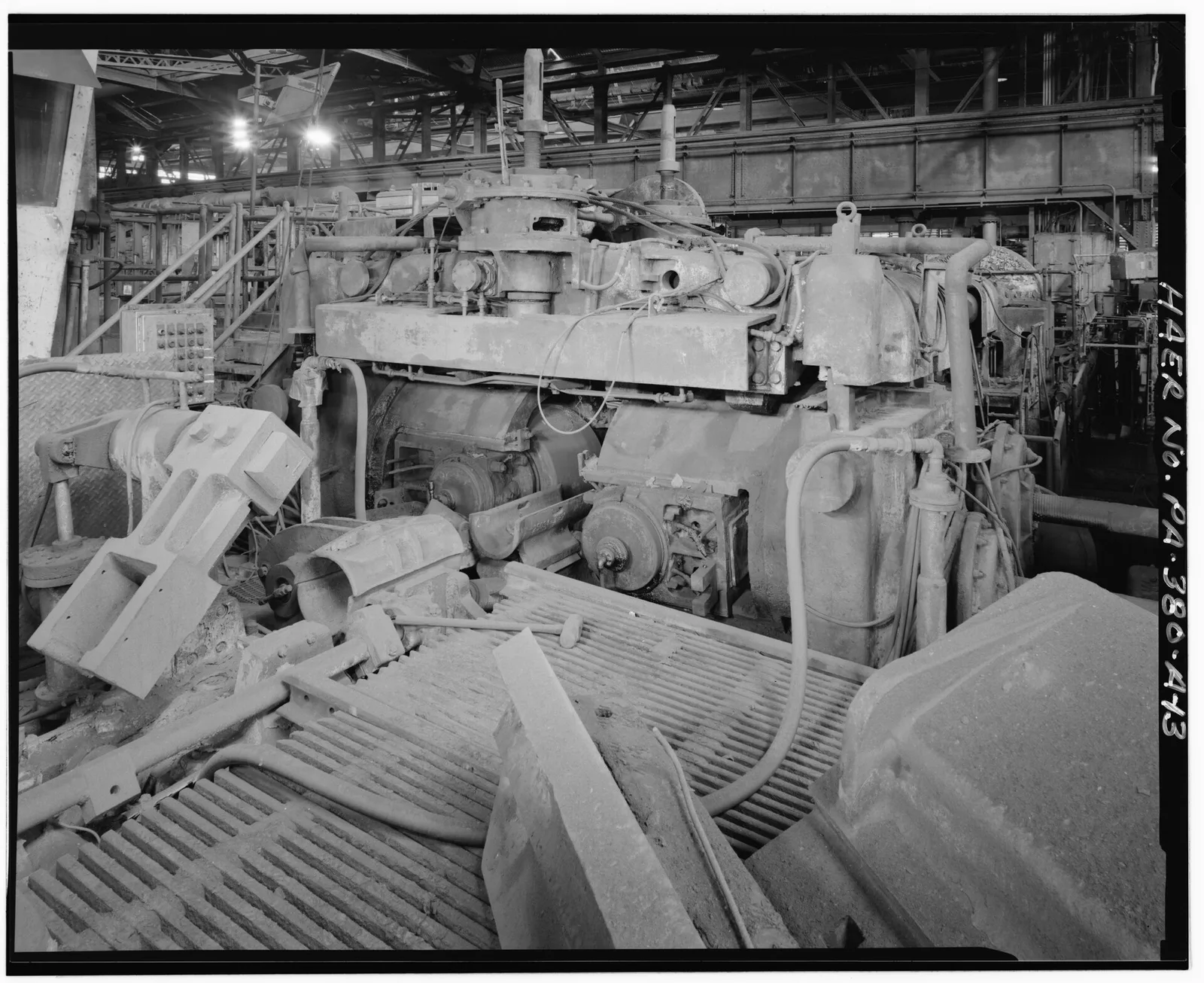
Cover photo: the piercer stand and Mannesmann rolls of a seamless pipe line, archival photograph. Credit: Martin Stupich / Historic American Engineering Record, Library of Congress (public domain); licence Public Domain Mark 1.0; original file page. Resized and converted for this page; the photograph is illustrative and is not connected to any named mill in this article.
What the two mill surveys show
Mysteel’s weekly survey of 30 seamless pipe producers put output at 386,500 tonnes for 5–11 November, down 15,500 tonnes week on week, with capacity utilisation at 77.52 percent (down 3.11 points) and the operating rate at 68.32 percent (down 1.98 points). Mill-side inventory slipped to 912,400 tonnes, down 10,800 tonnes (Mysteel, 12 November). That is the second straight decline: the previous two weeks printed 422,900 and 402,000 tonnes with utilisation at 84.81 and 80.63 percent (Mysteel survey archive) — meaning weekly output has now crossed below the 400,000-tonne mark that Mysteel’s November outlook flagged as the level that would meaningfully relieve inventory pressure. We covered the start of that sequence in our 4 November piece on the Liaocheng alert.
Lange’s independent tracking points the same way: a composite operating rate of 70.12 percent across the mills it surveys, down 0.33 points, with the decline decelerating rather than accelerating, and inventory at its 46 tracked mills down 13,800 tonnes to 851,400 tonnes (Lange Steel weekly, 13 November). Lange also makes the causal point explicitly: mills are cutting schedules preemptively against the off-season, not because demand has improved.
Smog curbs and a November maintenance wave
The immediate squeeze is regulatory. Hebei’s Handan, Xingtai and Baoding have been running Level I emergency responses, Tangshan and Cangzhou Level II, and Liaocheng — the heart of the Shandong cluster — remains under an orange alert; Mysteel estimates the curbs cost about 30,000 tonnes of seamless pipe output in a single week (Mysteel, 16 November). Lange’s regional read confirms Liaocheng’s differentiated production cuts are still binding on small billet-re-rolling tube capacity (Lange Steel weekly).
On top of that, November’s planned overhaul calendar is unusually heavy. Qujing Hengte Steel in Yunnan stopped its steelmaking plant for 19 days from 10 November for a grid upgrade, an estimated 95,000 tonnes of crude steel and about 50,000 tonnes of seamless pipe (Mysteel, 2 November). Hunan Valin’s Lianyuan Steel plans a 65-day overhaul of one 3,200 m³ blast furnace from 20 November at roughly 400,000 tonnes of steel products per month — a flat and long-products event, not a tube-line outage (Mysteel, 3 November); the company’s own procurement portal shows the No. 7 blast furnace and sintering upgrade project already in execution, with turnout-repair tenders opened and awarded on 10 November (LYSteel notice). Billet supply is also tightening at the edges: Tianjin Rockcheck’s heavy-bar line entered a 40-day modification on 9 November (about 110,000 tonnes of special-bar-quality steel) and Changqiang Steel’s bar line began a 70-day overhaul on 5 November (about 170,000 tonnes) (maintenance roundup, 6 November).
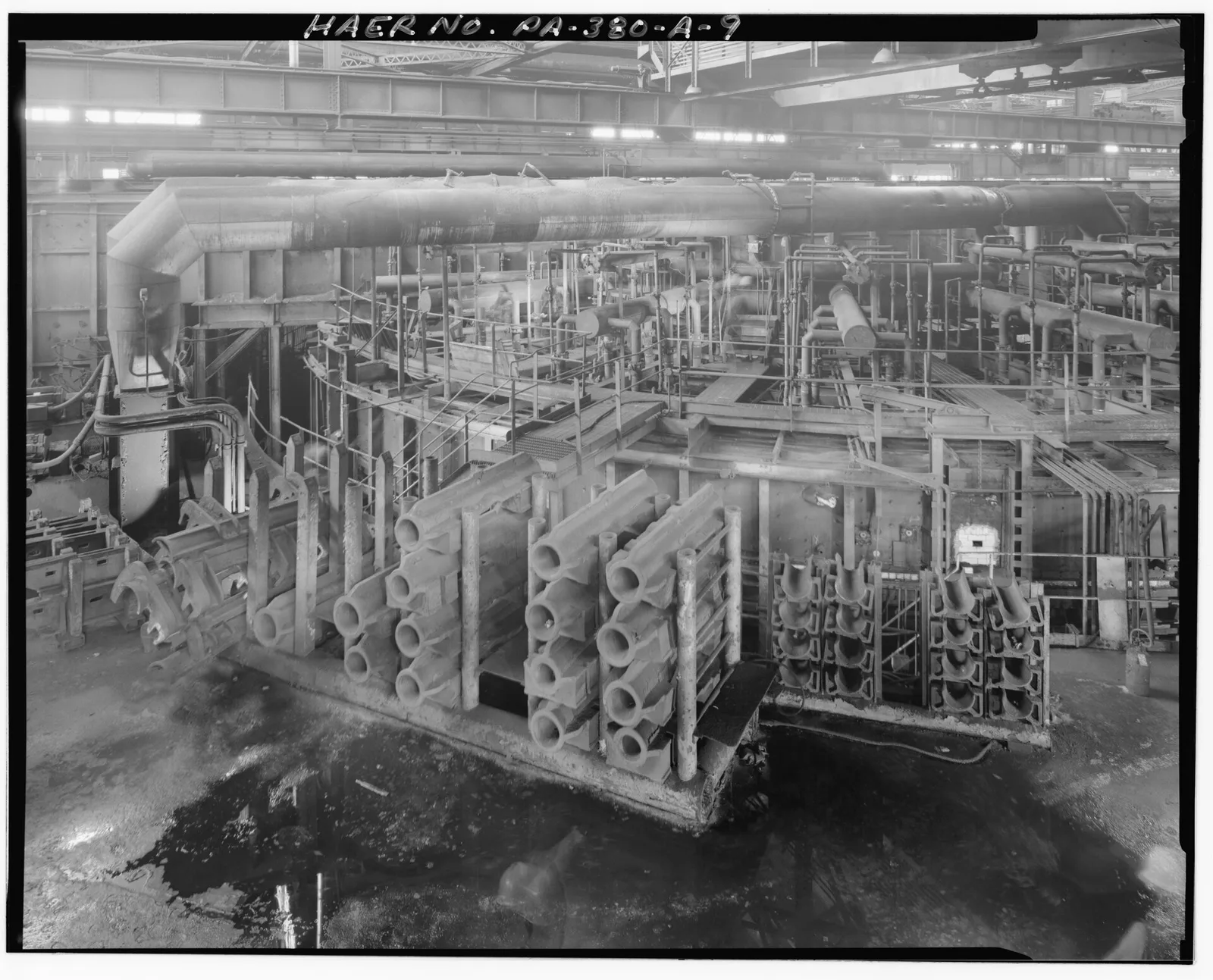
Photo: the rotary hearth furnace of a seamless line, where rounds are reheated before piercing — the process step that overhaul calendars interrupt. Credit: Martin Stupich / Historic American Engineering Record, Library of Congress (public domain); licence Public Domain Mark 1.0; original file page. Resized and converted for this page; archival photograph, not a picture of the mills named above.
The weather driver fades in late November
The ministry-level forecast is the reason not to extrapolate the cut. The Ministry of Ecology and Environment’s 16 November consultation for the second half of November expects mostly favourable dispersion with good-to-moderate air quality; in the Beijing-Tianjin-Hebei region, 18–20 November should be mostly excellent-to-good, with only western Shandong flagged for light-to-moderate pollution on the 23rd (MEE, 17 November; Tencent News relay; STCN relay). The first-half squeeze had a clear meteorological cause — the first-half forecast warned of exactly the stagnant episodes that triggered the Level I responses. Once dispersion improves, emergency curbs lapse, and Mysteel’s analysis warns idled capacity tends to come back quickly, pressing prices again unless maintenance keeps it offline (Mysteel, 16 November).
Capacity is rigid; exports carry the gap
The structural backdrop limits how much any of this matters for price. Mysteel puts 2026 industry capacity at about 46.46 million tonnes, up 7.19 million tonnes from 2020, with capacity utilisation at 69.07 percent — the lowest since 2020 — and average Shandong tube-mill margins at minus 103 yuan per tonne, a second consecutive loss-making year. January–September seamless pipe exports reached 4.539 million tonnes, up 0.78 percent year on year, an export dependence near 19.6 percent, and the January–July Middle East share collapsed from 31.91 to 17.31 percent as Southeast Asia and Algeria took share (Mysteel, 16 November). The macro demand side is no help: October steel output fell 5.1 percent year on year to 111.61 million tonnes (NBS), and January–October fixed-asset investment fell 8.1 percent with manufacturing down 2.9 percent and real estate down 21.6 percent (gov.cn, 16 November) — we tied those numbers to pipe demand in last week’s macro report.
Spot readings agree the market is bottoming rather than turning: the key-city average for 20# 108×4.5 mm seamless pipe stood at 4,190 yuan per tonne on 17 November with billet around 3,200 yuan, and Shandong’s 21 tracked mills shipped 18,200 tonnes on the day, down slightly (Lange daily, 17 November; Lange morning alert). Mysteel expects another 1.15 million tonnes of new seamless capacity in 2027, which caps any structural repricing (Mysteel, 16 November).
What it means for seamless pipe buyers
The contraction is real but passive, and mostly reversible. For buyers of structural and mechanical seamless pipe, commodity fluid and structural sizes stay negotiable and widely available; the squeeze is sharpest at the billet-re-rolling end of the Shandong cluster, so specification-critical orders — casing and tubing and boiler grades — deserve confirmed rolling schedules rather than list-price assumptions. Our primer on where seamless pipe prices stand in 2026 explains how to read mill-level moves like these. If you buy against project timelines, our team can help you plan around Shandong supply windows — see contact for a quote.
Sources
- Mysteel数据:全国无缝管厂产量、库存均有下降(11.5-11.11)— 我的钢铁网
- Mysteel:供需错配下的低位磨底——11月无缝管市场分析 — 我的钢铁网
- 兰格视点:一周钢市晚报(无缝管开工回落 厂库小幅减少)— 兰格钢铁网 via 腾讯新闻
- 兰格无缝管日盘点:成本支撑松动 短期无缝管维持弱运行 — 兰格钢铁网 via 新浪财经
- 11月17日兰格无缝管早间预警 — 兰格钢铁网 via 新浪财经
- 生态环境部发布11月下半月全国空气质量预报会商结果 — 生态环境部
- 生态环境部发布11月上半月全国空气质量预报会商结果 — 生态环境部
- 生态环境部发布11月下半月全国空气质量预报会商结果 — 腾讯新闻(人民财讯)
- 生态环境部发布11月下半月全国空气质量预报会商结果 — 证券时报网
- 炼铁厂7#高炉及烧结等配套系统提质升级改造项目(公辅配套)道岔大修中标候选人公示 — 湖南华菱涟源钢铁
- 涟钢3200m³高炉检修快讯 — 我的钢铁网
- 曲靖恒特停产检修快讯 — 我的钢铁网
- 河北应急响应与聊城橙色预警、无缝管周产快讯 — 我的钢铁网
- 多家钢厂宣布停产检修!影响超100万吨 — 网易号/钢贸圈
- 【钢铁资讯】多地钢厂宣布停产检修!影响超100万吨!— 新浪财经(中国炼铁网)
- 2026年10月份规模以上工业增加值增长4.8% — 国家统计局
- 10月份国民经济运行总体平稳、向新向优 — 中国政府网