APA Commits A$700 Million to Australia's Bulloo Interlink Gas Pipeline
APA Group announced on 22 October 2026 that it has taken a final investment decision on the Bulloo Interlink Pipeline, committing A$700 million to build and commission an 800 TJ/day high-pressure gas transmission line from the South West Queensland Pipeline in Queensland to the Moomba to Sydney Pipeline in New South Wales. The decision is the point at which a long-flagged project becomes steel in the ground, and the company says line pipe procurement is already well progressed.
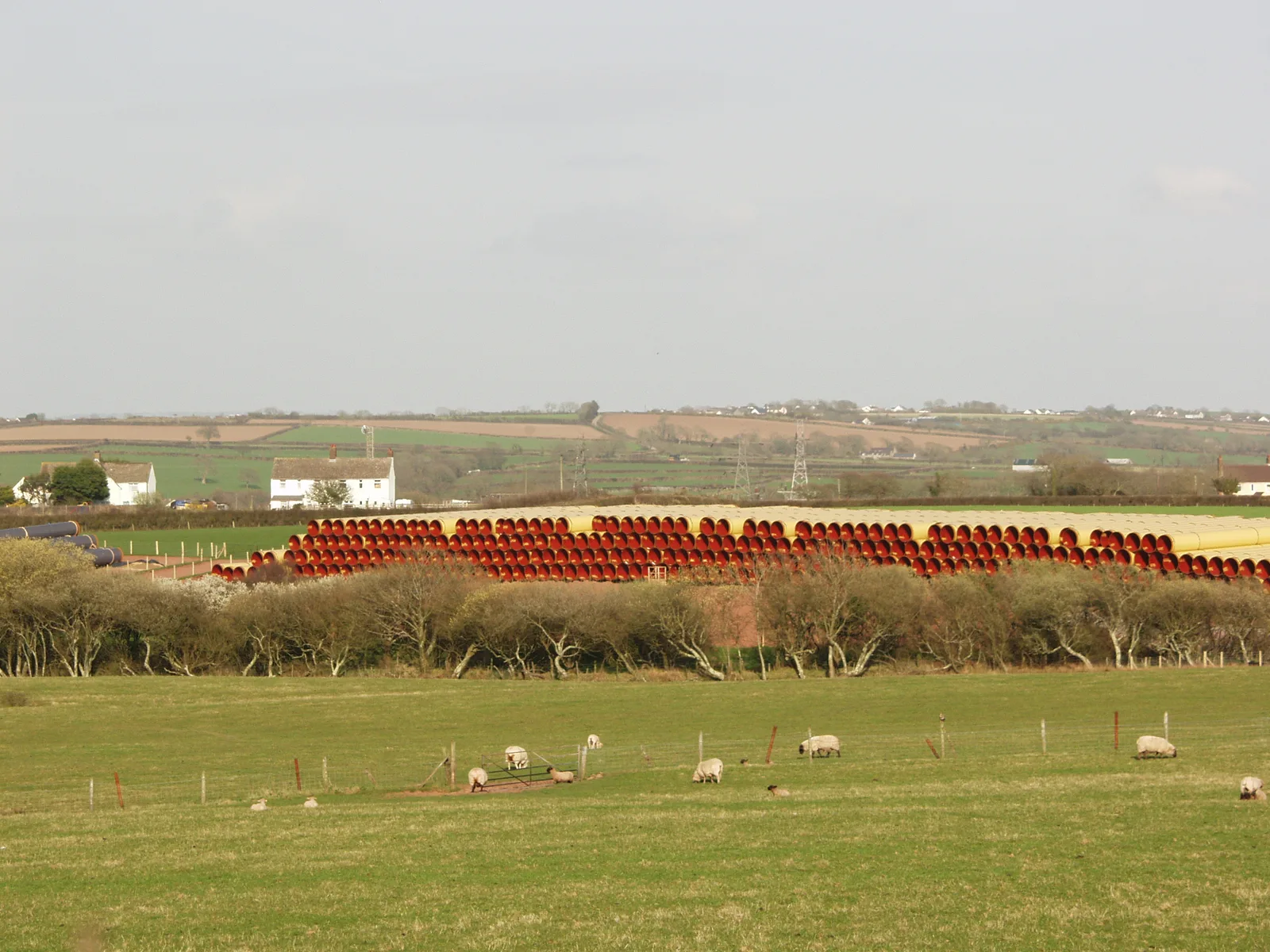
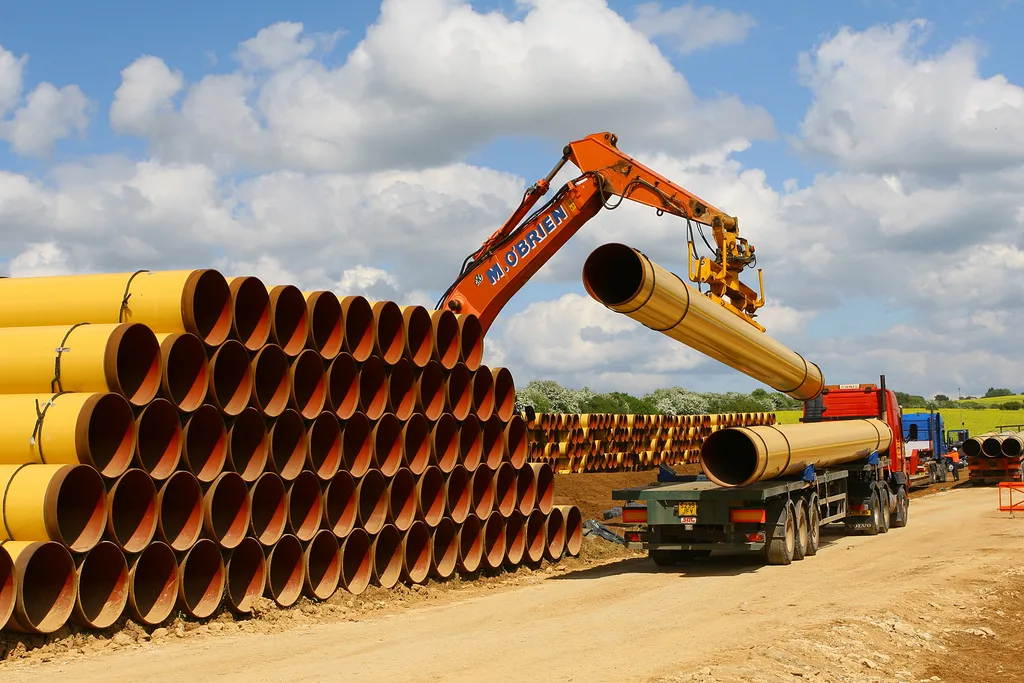
Cover photo: large-diameter coated line pipe stacked along a cleared pipeline corridor, resized and converted for this page. Credit: Neil Theasby (Wikimedia Commons / geograph.org.uk); licence CC BY-SA 2.0; original file page. The photograph is illustrative, was taken on an unrelated UK pipeline job and is not a picture of the Bulloo Interlink route.
What APA decided, and what it cost
The APA Group announcement states that the final investment decision “commits $700 million for the construction and commissioning of the BIL”, and that this is in addition to the A$220 million the board approved in February 2026 to progress early works. The same numbers appear in the chairman’s and chief executive’s remarks published the same day in the 2026 annual meeting speeches, which also confirm that Stage 3A carries A$260 million.
Three independent summaries of the same ASX filing carry the figure: SureStone Capital, Kalkine Media and the Newsquawk pre-market note. They are separately edited reports by different publishers, so they count as independent sources; all three still trace back to the same ASX announcement rather than to three separate verifications of it.
The financial logic rests on a customer contract rather than on a demand forecast. The decision is supported by a five-year, take-or-pay, inflation-linked gas transport and storage agreement with Origin Energy, with the new services starting on 1 January 2028 at the end of Origin’s existing arrangements. Take-or-pay means the customer pays for contracted capacity whether or not it uses it, which is why APA can commit construction capital before the line carries a molecule.
The schedule that pipe suppliers are working to
Construction is due to begin in early 2027, subject to relevant approvals, and targeted commercial operation is winter 2029, with revenue expected to ramp up over about five years after commissioning. Two items in the release matter more to a pipe mill than the capital number.
First, procurement is no longer speculative: the February 2026 early-works approval funded long-lead items, and the announcement describes “line pipe procurement, engineering, approvals and related development activities well progressed”. Second, the release does not disclose diameter, wall thickness, steel grade, tonnage or supplier. Buyers and competitors should therefore treat the pipe package as committed but unpublished, and watch for the line pipe award rather than assume what it contains.
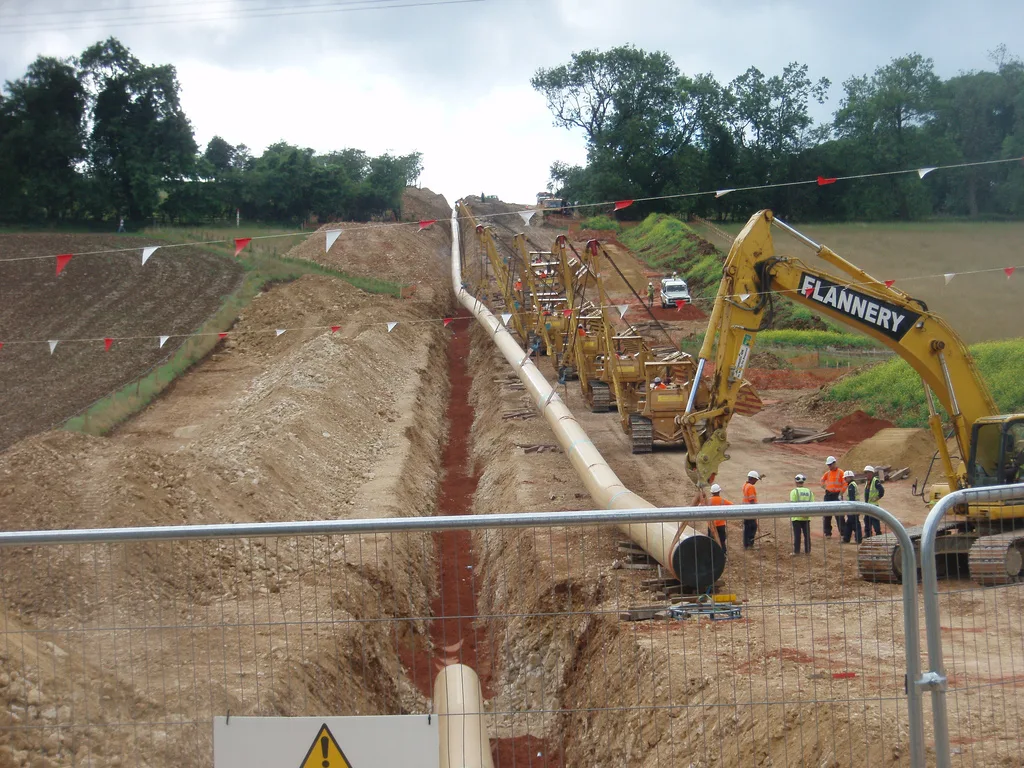
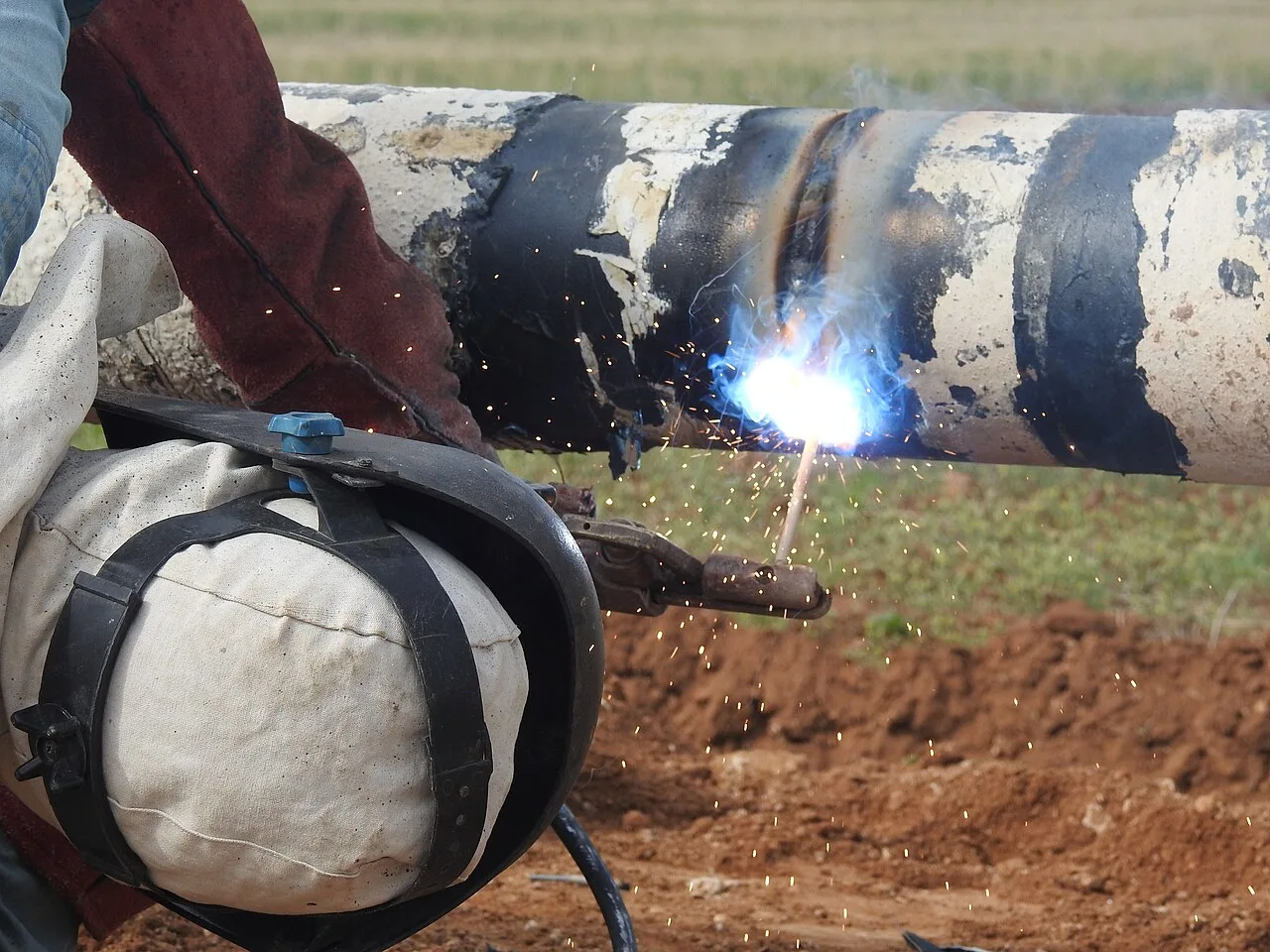
Image: a welded steel pipeline string being laid into an open trench, resized and converted for this page. Credit: PROJECT_MANAGER (Wikimedia Commons); licence CC BY-SA 2.0; original file page. It shows onshore pipeline installation practice and is unrelated to the Bulloo Interlink project.
Why the capacity is being built at all
APA frames the project as a response to the market operator’s forecast, not as a growth bet. The Australian Energy Market Operator’s 2026 Gas Statement of Opportunities release says gas production from legacy fields in southern states is forecast to decline by 46% over the next five years, and that new investment will be required to address emerging supply gaps from 2030 under most weather conditions. The Bulloo Interlink is designed to move northern gas south before that gap opens.
The project is Stage 3B of APA’s East Coast Gas Grid expansion. In August 2026 Storage Terminals Magazine reported that the line had entered the Commonwealth environmental assessment process, that it would shorten the existing north-to-south corridor by about 240 km and that the company was then targeting a final investment decision later in the year. Today’s announcement is that target being met.
Regulatory precedent on the same network points the same way. On 17 July 2026 the Australian Energy Regulator approved A$243.8 million of capital expenditure for APA, including two new compressor stations on the Victorian South West Pipeline, explicitly to address supply shortfalls AEMO forecasts for 2029. That is a compression project rather than a new trunk line, and Energy Today reported the same decision with the A$213 million figure APA uses in its own announcement.
What this means for line pipe demand and for seamless mills
A gas transmission line is mostly not a seamless product. Australian onshore transmission lines are built from large-diameter welded line pipe, typically API 5L in grades from X52 upward, and the size band decides the process route. Seamless pipe remains in the picture for smaller-diameter, higher-pressure or special-grade sections, for station piping, and for the hot-tap and tie-in work that a compressor or offtake connection requires. Anyone reading today’s announcement as a seamless order is reading it wrong; anyone reading it as irrelevant to seamless mills is reading it wrong in the other direction.
For scale, the next trunk line behind this one is larger. Queensland’s Office of the Coordinator-General records that Stage 2 of the North to East Australia Pipeline comprises 899 km of transmission pipeline, with key features including “a buried steel gas pipeline up to 48 inches in diameter”, at a capital cost of A$2.75-3 billion and a construction window of 2029-2034. Where Bulloo is an interlink, that project is the volume event.
The same pattern is running elsewhere. SEE Energy News reported on 21 October that the first pipes for Serbia’s 145 km interconnector with North Macedonia have been delivered, with enough pipe for about 15 km due by the end of October. World Pipelines lists 527 km and 470 km export lines tied to Argentine LNG. In China, Sinopec’s natural gas division is tendering 630 tonnes of seamless line pipe, 377 mm outside diameter by 9 mm wall in grades L360N/X52N to GB/T 9711, under the 2026 framework agreement for its Qibuqu diversion project; bids close at 09:00 on 23 October 2026 and only mills that have cleared Sinopec’s 2026 carbon seamless pipe pre-qualification may take part.
For comparison, the Caspian shows what a combined order looks like. Vallourec’s press release of 12 October 2026 covers OCTG and about 159 km of coated line pipe for TotalEnergies’ Absheron field, more than 16,000 tonnes in total, as Caucasus Business Journal and Mysteel’s international pipe round-up also reported. That single package bundles two very different products, which is the shape most LNG and gas-development awards take.
What buyers and suppliers should watch next
Three things are worth monitoring rather than guessing at. The pipe award itself: whether the line pipe is procured as one package or split by spread, and whether any high-pressure or station sections go to seamless mills. The approval calendar: construction is conditional on relevant approvals, and environmental conditions can move a spread start. And the contract structure: a take-or-pay anchor with Origin means the revenue case does not depend on spot gas prices, which makes the project less likely to be deferred than a merchant pipeline.
For product context, see Xbang’s API 5L line pipe and ASTM A106 carbon steel pipe pages, the guide to seamless steel pipe for oil and gas pipelines, and the explanation of how seamless and welded pipe differ. Those pages describe product capability; they are not a quotation for this or any project, and the figures above are the project owner’s, not Xbang’s prices.
Sources
- APA Group — APA to progress Bulloo Interlink Pipeline to address predicted gas market shortfalls, supported by agreement with Origin Energy
- APA Group — 2026 APA Annual Meeting, Speeches
- Australian Energy Market Operator — Near-term gas supply outlook improves, longer-term investment needed (2026 GSOO)
- Australian Energy Regulator — AER makes a final determination on APA’s advanced capital expenditure proposal
- APA Group — APA welcomes AER decision to approve $213 million expansion of South West Pipeline in Victoria
- Energy Today — AER approves $213m expansion of Victoria’s South West Pipeline
- Storage Terminals Magazine — APA progresses East Coast Gas Grid Expansion Plan with Bulloo Interlink Pipeline environmental assessment
- Kalkine Media — APA Group (ASX:APA) Backs Bulloo Interlink Pipeline, Inks Origin Deal
- SureStone Capital — APA Commits $700M to Bulloo Interlink Pipeline
- Newsquawk — Pre-market Australian stock news, 22 October 2026
- Queensland Office of the Coordinator-General — North to East Australia Pipeline (Stage 2) project
- SEE Energy News — Serbia readies €153 million gas interconnector with North Macedonia
- World Pipelines — The biggest natural gas pipeline projects you should know in 2026, Part 2
- Vallourec — Vallourec awarded major contract by TotalEnergies for the Absheron gas field in Azerbaijan (PDF)
- Caucasus Business Journal — Vallourec to Supply 16,000 Tonnes of Pipe for Absheron
- Mysteel — 国际钢管热点汇总:韩国反倾销调查启动 欧盟配额告罄 国内出口弱稳运行(10.10-10.16)
- Sinopec Natural Gas Company — 2026 framework tender for seamless line pipe, 377 mm x 9 mm L360N/X52N GB/T 9711, 630 tonnes
- Tecnicas Reunidas — TR strengthens its presence in North America with a new contract awarded by LNG Canada
- Pipeline Technology Journal — Spanish Firm Wins $220 Million Contract for Canadian Pipeline Expansion